Tuesday, August 9, 2022

The Most Popular Spaces to Remodel and Their Costs


Since the pandemic began, homeowners have been eager to spruce up their spaces. Even recently, homeowners are spending more on home improvement projects than they have—due partially to higher building material costs, but also to a desire to widen the scope of their projects.


Kitchens and bathrooms continue to be the most popular areas to renovate, according to the 2022 U.S. Houzz & Home Study. The median spend in 2021 on a kitchen remodel was $15,000, a 25% increase from 2020. A guest bathroom expenditure costs a median of $4,400, a 38% year-over-year increase, according to Houzz’s report.


According to the Houzz survey, among remodeling homeowners, paint is by far the most common purchase. Sixty-five percent said their home renovation included paint, followed by new light fixtures (51%), faucets and showerheads (46%), and lawn and garden supplies (45%).


Source: “Here Are the Most Popular Remodeling Projects,” Houzz.com (May 11, 2022)


Monday, August 8, 2022

Mortgage Rates Dip Below 5%; Buyers Get ‘A Second-Chance Opportunity’


The average monthly mortgage payment has fallen 12% reduction in just two months as high borrowing costs moderate, says NAR Chief Economist.


After weeks of escalating borrowing costs, home buyers are getting a second chance to lock in lower rates. The 30-year fixed-rate mortgage fell to an average just below 5% for the week ending Aug. 4, Freddie Mac reports.


With rates dipping in recent days, mortgage applications are increasing for the first time in five weeks, the Mortgage Bankers Association reported this week. Applications for a home purchase increased 1% last week following weeks of declines as home buyers and refinancers got spooked by higher mortgage rates.


Will the latest lower rates stick around? “Mortgage rates remained volatile due to the tug of war between inflationary pressures and a clear slowdown in economic growth,” says Sam Khater, Freddie Mac’s chief economist. “The high uncertainty surrounding inflation and other factors will likely cause rates to remain variable, especially as the Federal Reserve attempts to navigate the current economic environment.”


Last week, National Association of REALTORS® Chief Economist Lawrence Yun predicted that the Federal Reserve’s decision to raise its short-term fed funds rate by 75 basis points was unlikely to do any further damage to mortgage rates. “The mortgage and longer-term bond markets have settled down in recent weeks,” Yun says. “The peak in mortgage rates may have already occurred. That’s because oil and gasoline prices have been falling lately and, hence, will lessen broader inflationary pressures. Lower inflation means less aggressive interest rates by the Federal Reserve.”


Any decline in mortgage rates is likely relief to potential home buyers. “Though still higher than a year ago, the current rate of under 5% means around a 12% reduction in monthly payments compared to when mortgage rates peaked at 6% just two months ago,” Yun says. “Mortgage rates could soon turn upward but are unlikely to retouch the 6% mark. Any dip should be viewed as a second-chance opportunity.”


Freddie Mac reports the following national averages with mortgage rates for the week ending Aug. 4:


  • 30-year fixed-rate mortgages: averaged 4.99%, with an average 0.8 point, dropping from last week’s 5.30% average. Last year at this time, 30-year rates averaged 2.77%.

  • 15-year fixed-rate mortgages: averaged 4.26%, with an average 0.6 point, falling from last week’s 4.58% average. A year ago, 15-year rates averaged 2.10%.

  • 5-year hybrid adjustable-rate mortgages: averaged 4.25%, with an average 0.3 point, dropping from last week’s 4.29% average. A year ago, 5-year ARMs averaged 2.40%.


Freddie Mac reports commitment rates along with average points to better reflect the total upfront cost of obtaining the mortgage.


Friday, August 5, 2022

Federal Reserve's inflation-busting tactics slammed


The Federal Reserve’s apparent inability to rein in runaway inflation is hitting the pockets of ordinary homeowners as they struggle to cope with rising mortgage rates and the cost-of-living crisis, Melissa Cohn (pictured), regional vice president at William Raveis Mortgage, has said.


Cohn, a mortgage industry veteran with more than 40 years’ experience, said the speed at which mortgage rates had increased had caught her by surprise, adding that spiraling inflation and the apparent inability by the Federal Reserve to control matters would soon begin to take their toll on borrowers.


“The biggest surprise is just how far and how fast rates have gone over the course of the past three months. We were living under the understanding that the Fed said that inflation was transitory, and they were wrong,” she said, adding that the “massive increase” in interest rates “is really hurting the economy”.


Interest rates for 30-year fixed mortgages have risen steadily since January, when they were hovering around the 4% mark before surging well past the 6% barrier in June.


Rates nonetheless appear to have levelled out more recently and are now hovering around 5.57%, down by roughly 27 basis points in the last seven days, according to Bankrate.


Cohn made the comments last week, shortly before the Federal Reserve increased the base rate by 75 percentage points for the second month in a row.


Cohn, who had been much more bullish about the country’s economic prospects before the Russian invasion of Ukraine, said the fuel supply chain disruptions caused by the conflict had made inflation worse – and the Fed appeared to have no answer.


“Raising interest rates is not going to necessarily moderate any of those things. But I think that’s just due more to the fact that although the levels of consumption are going down, the war in Ukraine is not ending,” she said.


She criticized the Fed for focusing primarily on employment over the past two-and-a-half years “at the cost of the economy”, with layoffs as a result.


She said homebuyers were feeling the pinch especially because wage rises were not keeping up with inflation. Asked how this compared to when she started out in the industry decades ago, she said:


“This is a much more punishing rate of inflation. Things like the rate at which we’ve earned money in our bank or savings accounts has also not increased to be more reflective of the rate of inflation,” she pointed out.


On the upside, Cohn reckoned the housing market was now undergoing a “much healthier” period of “normalization” with figures showing that the sector was slowing down.


According to recent data, existing home sales have been falling for the past five months, while mortgage applications are at a 22-year low and purchase volume is down by 90% compared to a year ago.


Cohn said the current market conditions would offer sensible opportunities for prospective homebuyers and also separate the wheat from the chaff in the mortgage industry.


“We’re all hopefully going through a period of normalization where we are no longer just in a frenzy-fueled seller’s market, and where buyers have the ability to go out and look at one or even 10 houses and are able to contrast and compare without having to be forced to bid.”


Having to fight for a shrinking share of the market, with the looming threat of a recession making lenders more cautious, was not a bad thing necessarily, she argued.


“It’s time for the cream to rise to the top and that we make sure that we have a well-educated, well-seasoned industry. It’s no longer a case of becoming a mortgage broker because everyone’s selling loans at 3%,” she remarked.


“When we go into a trickier economic cycle and people don’t necessarily always qualify so easily and simply, you need to do a better job of educating and making sure you’re finding the right product and the right loan for your consumer.”


02 Aug 2022


Thursday, August 4, 2022

4 DIY Jobs Sellers Should Stop Doing


Homeowners may have gotten overconfident with their DIY skills. Armed with YouTube tutorials and extra time at home during the pandemic, more homeowners have been drawn to DIY house projects to save money and bypass waits for overbooked contractors. Home inspectors are seeing the results of that DIY surge. When homeowners go to sell, they say more DIY jobs are popping up as red flags.


“We want homeowners to be handy, but we want them to be careful about what they choose to do to their home,” says Adam Long, president of the HomeTeam Inspection Service, which has 200-plus offices nationwide. “It’s important to know when to call in a professional. Saving $200 to $300 for an electrician or plumber could end up costing you thousands in the end.”


Here are the areas where home inspectors are noticing an uptick, Long says.


#1 Electrical Work


Common DIY tasks: Installing a lighting fixture, ceiling fan, or dimmer switch


Risks: Electrocution and home electrical fires


Red flags: Inspectors are spotting overloaded circuit boxes, wires left exposed or the wrong wires being used, and improper junction boxes. “Any changes in the electrical box can be problematic, even when it seems minor like adding a dimmer or wall switch or even a Wi-Fi–enabled switch,” Long says. Personal dangers aside, faulty wiring can cause shorts that lead to house fires. Further, homeowners who do their own electrical work may have failed to get the necessary permits—approvals from municipalities that shows a job was done to code. Failing to get permits can result in fines and hold up a home sale.


#2 Plumbing


Common DIY tasks: Changing a faucet or appliance


Risks: Water leaks or flooding to the home and mold


Red flags: Plumbing that is wrongly installed or repaired can cause significant damage to a home, such as flooding and eventual wood rot and mold growth, which can affect air quality and human health. “Be careful any time you do anything with the home’s plumbing to make sure you are doing it safely and correctly,” Long says. Homeowners may be tempted to change a faucet or update an appliance like a dishwasher. But one wrong connection can lead to costly damage. A dishwasher requires lots of water pressure. If it’s not properly hooked up, homeowners could experience significant flooding in a kitchen.


#3 Roofing & Decks


Common DIY tasks: Installing or extending a new deck or repairing roof shingles


Risks: Injuries from falls and damage to the home


Red flags: Home inspectors say DIY deck installations often are improperly attached to the house or have loose, insecure handrails, both of which pose safety concerns. With roofs, homeowners may try to replace a shingle. “Professionals take extra precautions and know how to stay safe on the roof while making repairs,” Long says. Decks and roofs are some of the highest-priced home items to fix—and where the labor tends to be more expensive than materials, homeowners are too often tempted to do it themselves for the savings, Long says.


#4 Landscape Grading


Common DIY tasks: Adding landscaping or outdoor elements that change water flow around the home


Risks: Improper draining, flooding, and structural damage


Red flags: Inspectors may spot puddles of water around the home’s foundation. When the house was built, the yard was graded so that water would flow away from the home. But after a few years, grading may not have been properly maintained. This can cause water to rush around the foundation and lead to structural damage or water entering a basement or crawl space. “This one is an easy one to pay attention to, especially when it’s raining,” Long says. “That’s the best time to check that water is moving away from the foundation. The gutters should be directing water away from the foundation, too.”


Wednesday, August 3, 2022

The 10 Best - and Most Affordable - Places To Retire in America, 2022 Edition


After a lifetime of hard work, two-plus years of dealing with COVID-19, and the current uncertain stretch of economic rockiness right around the curve, many older adults are chomping at the bit to exit the 9-to-5 hustle. Pronto.


But, for more Americans, the idea of retirement seems like it could be a long way off. Housing prices have skyrocketed since the start of the pandemic—making the time-honored strategy of selling the family home, downsizing into a cheaper forever abode, and banking the extra equity way less assured. Stocks and bonds have dropped significantly, also eroding many nest eggs, and inflation is rising at the fastest pace in more than 40 years.


Those compounding factors have led some experts to say that 2022 is a “dangerous time to retire.”


After a lifetime of hard work, two-plus years of dealing with COVID-19, and the current uncertain stretch of economic rockiness right around the curve, many older adults are chomping at the bit to exit the 9-to-5 hustle. Pronto.


But, for more Americans, the idea of retirement seems like it could be a long way off. Housing prices have skyrocketed since the start of the pandemic—making the time-honored strategy of selling the family home, downsizing into a cheaper forever abode, and banking the extra equity way less assured. Stocks and bonds have dropped significantly, also eroding many nest eggs, and inflation is rising at the fastest pace in more than 40 years.


Those compounding factors have led some experts to say that 2022 is a “dangerous time to retire.”


1. Traverse City, MI


2. Portland, ME


3. Salisbury, MD


4. Myrtle Beach, SC


5. Bloomington, IL


6. Port St. Lucie, FL


7. Syracuse, NY


8. Wilmington, NC


9. Concord, NH


10. St. Louis, MO


Read the full article HERE


Tuesday, August 2, 2022

US home price growth: The tides have finally turned


Record-high home price growth in the US has finally turned a corner, giving the housing market a much-needed cooldown.


Home price appreciation logged its largest single-month slowdown on record since at least the early 1970s, with the annual growth rate plunging nearly two percentage points in June, according to Black Knight’s latest Mortgage Monitor report.


“For context, during the 2006 downturn, the strongest single-month slowing was 1.19% – about what we saw last month – and June topped that by 66%,” said Ben Graboske, president of Black Knight Data & Analytics. “The slowdown was broad-based among the top 50 markets at the metro level, with some areas experiencing even more pronounced cooling. In fact, 25% of major US markets saw growth slow by three percentage points in June, with four decelerating by four or more points in that month alone.”


While the pullback in June was record-breaking, Graboske noted that home price growth would need to decelerate at this pace for six more months for annual appreciation to return to the long-run average of about 5%.


“Given it takes about five months for interest rate impacts to be fully reflected in traditional home price indexes, we’re likely not yet seeing the full effect of recent rate spikes, with the potential for even stronger slowing in coming months,” he said.


The report also revealed significant changes in the demand-supply equation. Over the past two months, the number of homes listed for sale rose 22% at a seasonally adjusted rate. However, the market still has a long way to go before normalization – 54% below the number of listings from 2017 to 2019.


“With a national shortage of more than 700,000 listings, it would take more than a year of such record increases for inventory levels to fully normalize,” Graboske said. “Of course, some metro areas are seeing inventory return to the market more quickly than others.


“San Francisco officially returned to pre-pandemic levels in June, becoming the first major market to do so, with San Jose close behind, where the number of homes listed for sale is just 1% off the June 2017-2019 average. It’s therefore of little surprise to find both metros among the markets where prices are pulling back from recent highs, along with Seattle, San Diego, Denver and others.”


According to Black Knight, this could affect many borrowers who bought into the market at or near recent highs, as roughly 10% of mortgaged properties were purchased over the past year.


Additionally, sales activity has continued its downward trend over recent months due to rising rates and home affordability issues. Seasonally adjusted home sales have declined by more than 21% since the start of the year and are expected to continue going down in the coming months. The slowdown in sales has helped inventory to recover from record lows.


“Factoring in both active listings and sales volumes, the market has ticked up from a low of 1.7 months of inventory at the start of the year to 2.6 months as of June,” Black Knight wrote in the report. “If current trends continue to hold, months of inventory could continue to trend sharply upward in coming months. Black Knight will continue to monitor the situation and report its findings moving forward.”


Monday, August 1, 2022

Inching Closer to Recession


The next downturn may be different than the last. Look to commercial real estate for clues about the direction of the economy.


The U.S. gross domestic product contracted in the first quarter by 1.5%. The stock market has been tumbling. Inflation is stubbornly high. The Federal Reserve plans to continue raising interest rates. Pending home sales have fallen for six straight months and are now trending slightly below 2019 levels. The economy, in short, is on the verge of a recession.


Yet, it will not be a straightforward recession. Despite hiring freezes at tech firms and recent job cuts among mortgage lenders as refinance business dries up, the bigger problem for the economy is not a lack of jobs but rather a shortage of workers. Statistically, there are two job openings for each unemployed person. That’s why wages are up an average of 5.5% from a year ago, to nearly $32 per hour nationwide. However, inflation is gobbling the increase up with an 8% rise in the cost of living.


A recession typically means bad news for commercial real estate. But this time, the condition of the commercial market may be an indicator about the direction of the overall economy. Demand for apartments and single-family rentals is booming because of consistent job gains and affordability challenges in the For Sale market. Low vacancy rates, though, have pushed up average rents significantly this year. Demand for warehouse space has surged as retailers look to avoid supply-chain disruptions. The retail sector is recovering, with more fitness gyms, nail salons, and restaurants popping up in the suburbs. Hotel bookings, air travel, and park attendance, are above pre-pandemic levels. Consumer spending in the GDP calculation was up a solid 3.1%, even after adjusting for inflation. Weak trade numbers—exports were down and imports were up—brought the fall in GDP. Homeowners, after all, have accumulated sizable housing wealth: $75,100 in the last two years and $155,400 over the past five years. The stock market is going through a painful correction, though the broad S&P 500 index is up by 70% from five years ago. That’s why total net household wealth has essentially doubled from 10 years ago.


The office market is another story. There’s no strong desire on the part of employees to return to their downtown offices. Google’s GPS tracker shows robust movement just about everywhere except in office locations during work hours. Some form of working from home will be a permanent feature of the post–COVID-19 economy. This is also the reason traffic jams are happening more often on weekends than on weekdays. Welcome to the new normal.


Housing Inventory Edges Up


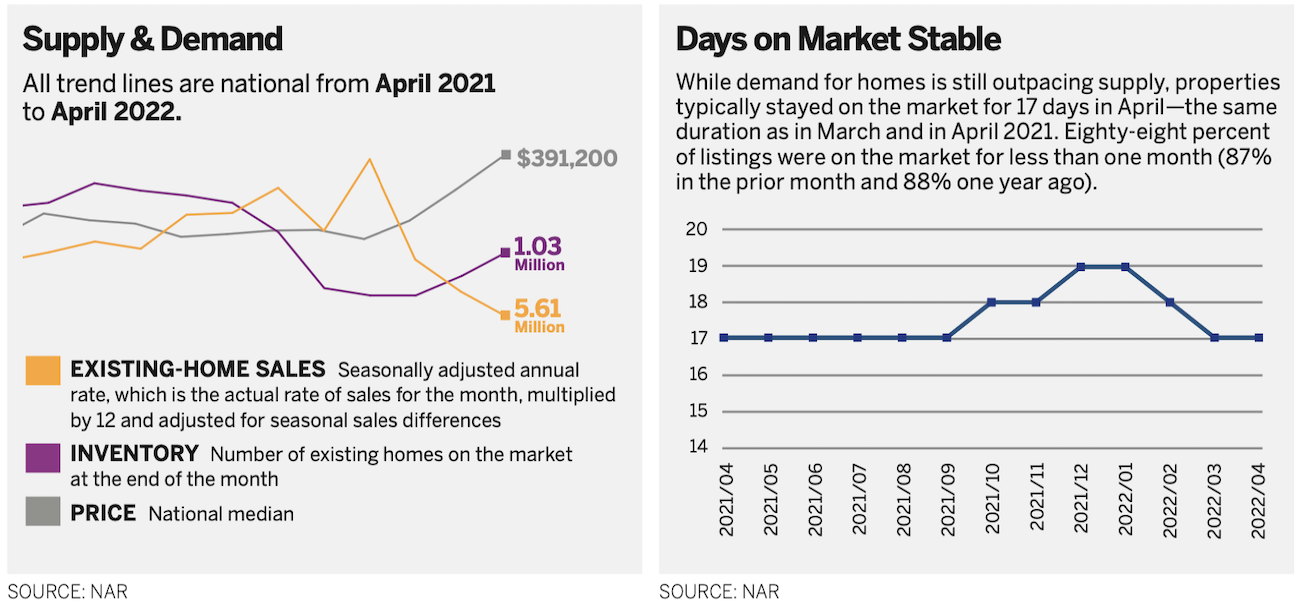
Total housing inventory at the end of April 2022 amounted to 1.03 million units, up 10.8% from March but down 10.4% from one year ago. At the current sales pace, there was a 2.2-month supply, up from 1.9 months in March and down from 2.3 months in April 2021.


Supply & Demand / Days on Market Stable


Lawrence Yun Lawrence Yun, Chief Economist and Senior Vice President of Research at the National Association of REALTORS®.  Yun oversees and is responsible for a wide range of research activity for the association including NAR’s Existing Home Sales statistics, Affordability Index, and Home Buyers and Sellers Profile Report. He regularly provides commentary on real estate market trends for its 1.3 million REALTOR® members.  Dr. Yun creates NAR’s forecasts and participates in many economic forecasting panels, among them the Blue Chip Council and the Wall Street Journal Forecasting Survey. He also participates in the Industrial Economists Discussion Group at the Joint Center for Housing Studies of Harvard University. He appears regularly on financial news outlets, is a frequent speaker at real estate conferences throughout the United States, and has testified before Congress. Dr. Yun has appeared as a guest on CSPAN’s Washington Journal and is a regular guest columnist on the Forbes website and The Hill, an “inside the beltway” publication on public affairs.  Dr. Yun received his undergraduate degree from Purdue University and earned his Ph.D. from the University of Maryland at College Park.