Thanks for visiting our blog, where we guarantee you'll find plenty of helpful information to assist you in purchasing your new home or refinancing your current mortgage.
We also like to post technology and local interesting news.
Enjoy!
Homes are still selling fast but a slowdown is evident in many markets. Amid rising mortgage rates that are pricing more buyers out, some home sellers are having to revisit their asking price.
Price drops are particularly more common in migration hotspots, places that have been relatively affordable but saw home values surge as more people have migrated in from coastal areas since the pandemic began, a new report from Redfin says. For example, in Boise, Idaho, home prices are up 62% over the past two years. In April, 41% of home sellers dropped their prices, the largest of 108 metro areas tracked by Redfin.
More than 20% of home sellers dropped their price in April in seven of the 10 most popular migration destinations, the report says. Other areas that are seeing a rise in price drops include Cape Coral, Fla. (at 33% in April); New Orleans (32%); Baton Rouge, La (31%); and Sacramento, Calif. (30%).
“Many places like Boise or Sacramento that saw a surge in migration and a sharp increase in home prices over the past two years have now seen an abrupt drop-off in demand, leading sellers to drop their prices with increasing frequency,” says Daryl Fairweather, Redfin’s chief economist. “When mortgage rates were at or below 3%, both local and out-of-town home buyers were more willing and able to tolerate high prices, but at 5%, many are priced out. A home’s price is driven by the balance of supply and demand, and when demand drops off and supply increases like it is now, rapid price increases evaporate quickly.”
Lawrence Yun, NAR’s chief economist, said in a recent release on the latest housing data that higher mortgage rates have increased the cost of purchasing a home by more than 25% compared to last year. In many cases, that could mean the higher mortgage payments are leading up to $500 more per month for borrowers. Further, higher home prices add another 15% to that figure, Yun says. Also, households are facing rapid inflation that is increasing everyday costs, like fuel and food.
For the third consecutive month, existing-home sales fell, but buyers are still eager. Higher mortgage rates and prices and low inventory continue to chip away at affordability. Some regions of the U.S., however, continue to see gains.
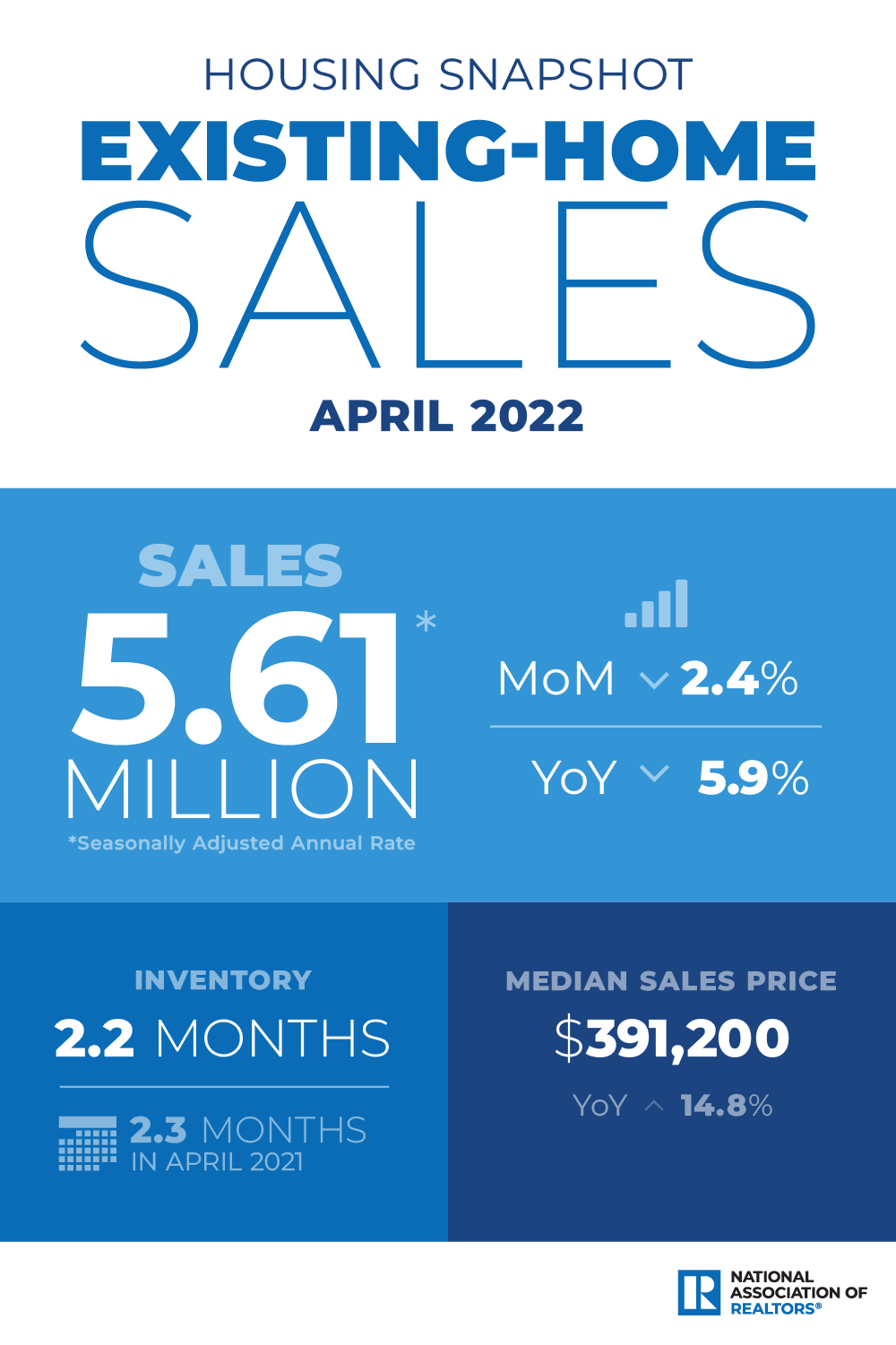
Nationwide, existing-home sales—completed transactions of single-family homes, townhomes, condos, and co-ops—decreased 2.4% in April compared to March, according to the National Association of REALTORS®’ latest housing report. Sales are down 5.9% year over year.
“The market is quite unusual as sales are coming down, but listed homes are still selling swiftly, and home prices are much higher than a year ago,” says Lawrence Yun, NAR’s chief economist.
Still, higher home prices and sharply higher mortgage rates are beginning to reduce buyer activity in many markets, he adds. “It looks like more declines are imminent in the upcoming months, and we’ll likely return to the pre-pandemic home sales activity after the remarkable surge over the past two months,” Yun says.
Here’s a closer look at the key indicators from NAR’s latest housing report.
Home prices: The median existing-home sales price increased at a slower year-over-year pace of 14.8% in April. Median home prices were $391,200 nationwide. Home prices continued to increase in every region of the U.S.
Days on the market: Eighty-eight percent of homes sold in April were on the market for less than a month. Properties remained on the market for 17 days in April, the same as last month and as a year ago.
First-time buyers: First-time home buyers comprised 28% of sales in April, down from 31% a year ago.
Investors and second-home buyers: Individual investors and second-home buyers accounted for 17% of home sales in April, the same as a year ago. These buyers tend to make up the bulk of all-cash sales, which accounted for 26% of transactions in April, also about the same as a year ago. “The cash buyers, not impacted by mortgage rate changes, remain elevated,” Yun says.
Distressed sales: Foreclosures and short sales remain historically low, representing less than 1% of sales in April and down from 2% a year earlier.
Housing inventory: Total housing inventory is up 10.8% in April compared to March and down 10.4% from a year ago. Unsold inventory sits at a 2.2-month supply at the current sales pace. “Housing supply has started to improve, albeit at an extremely sluggish pace,” Yun says.
Even with some improvement, the nation has a long way to go in reversing years of underbuilding and low inventory, NAR notes. “As we find ourselves in the midst of a massive housing shortage, NAR continues to work with leaders across the private and public sectors to help close this deficit,” says NAR President Leslie Rouda Smith. “As the nation’s largest real estate association, we are urging policymakers to enact zoning reforms, homebuilder incentives, and other necessary regulations to help correct this situation.” The Biden administration made an announcement this week with a proposal to try to improve America’s housing shortfall. Read more: Biden Administration Takes Aim at America’s Housing Shortage
Regional Breakdown
The following is a closer look at how existing-home sales fared across the country in April, according to NAR’s sales report.
Northeast: Existing-home sales increased by 1.5% in April, reaching an annual rate of 670,000, a 10.7% drop from a year ago. Median price: $412,100, up 8.1% from April 2021
Midwest: Existing-home sales rose by 3.1% from the prior month to an annual rate of 1.31 million in April, a 1.5% decrease from a year ago. Median price: $282,000, an 8.7% increase from one year ago
South: Existing-home sales dropped by 4.6% in April, recording an annual rate of 2.49 million, a 5.7% decrease from one year ago. Median price: $352,100, a 22.2% increase from a year earlier. The South is the only region to report year-over-year double-digit price gains.
West: Existing-home sales fell by 5.8% in April, reaching an annual rate of 1.14 million, down 8.1% from one year ago. Median price: $523,000, up 4.3% from April 2021
No matter where this weekend finds you, please join us in taking time to honor and remember our fallen. I hope you get to enjoy the freedom our heroes fought so hard to win. We encourage you to Thank a Veteran and remember those who fought for those freedoms.
Part of that freedom includes the American dream of homeownership. If you or someone you know is ready to realize that dream, it would be our honor to assist them. To find out more click HERE.
Taking advantage of growing interest in alternative office arrangements, two companies are teaming up to build a coworking giant that will allow firms to rent office space whenever they need it. IWG PLC, a flexible office operator and rival to WeWork, announced it was investing about $350 million in a venture with the Instant Group, which operates an online listing site for office space.
They are setting out to create the world’s largest online marketplace for flexible office arrangements, which The Wall Street Journal calls the “Airbnb of office space.” Tenants will be able to find and book office spaces and various other corporate accommodations, including hotel meeting rooms.
Since the pandemic began, demand has grown for furnished office space with short-term leases. Many companies have embraced hybrid work schedules, which is also sparking greater interest in on-demand meeting rooms and offices that can be booked by the day or hour.
Forty-one percent of office tenants in a mid-2021 survey conducted by the property brokerage JLL said they expect to use more flexible office space because of the pandemic. That is up from 29% in 2020.
IWG operates more than 3,000 office spaces worldwide under brands like Regus and Spaces. IWG and Instant Group say they plan to take their joint venture public within the next two years.
Still, vacancies in coworking spaces are prevalent despite growing demand, particularly in urban centers. Coworking giant WeWork Inc. said it was profitable in the fourth quarter of 2021 for the first time since the pandemic began, but a third of its space remains vacant.
Florida Realtors® worked closely with the Florida Legislature throughout the 2022 session to create HHHP (Hometown Heroes Housing Program). Funded at $100 million, the program is designed to help some of the state’s most essential workers become homeowners.
During a press conference in Southwest Florida on Monday, Florida Governor Ron DeSantis announced the launch of Florida Realtors® top 2022 legislative priority, the Hometown Heroes Housing Program (HHHP).
Administered by the Florida Housing Finance Corporation (FHFC), HHHP would reduce the upfront costs for qualifying hometown heroes by providing zero-interest loans to help with down payment and closing costs, up to a limit of 5% of the first mortgage loan or $25,000.
Florida Realtors® worked closely with the Florida Legislature throughout the 2022 session to create HHHP. Funded at $100 million, the program is designed to help some of the state’s most essential workers become homeowners.
“There are 1,000 lenders involved in the program to start providing assistance to essential workers, such as police officers, firefighters, doctors, nurses and teachers, among other professions,” says Florida Realtors® Vice President of Public Policy Andy Gonzalez.
More details about the program can be found on FHFC’s website.
“We are extremely grateful to the governor and the Florida Legislature for recognizing the tremendous housing burden that our hometown heroes face,” adds Pappas. “These professionals perform such a vital role in our daily lives. We should be doing everything possible to help them achieve the dream of homeownership.”
Realtor.com® made a game-changing decision two years ago, becoming the first real estate listing site to display properties’ flood risk. As a member of NAR’s Insurance Committee, I was proud to collaborate with realtor.com® to present this information in a consumer-friendly and factual way through a tool called Flood Factor, from the nonprofit First Street Foundation.
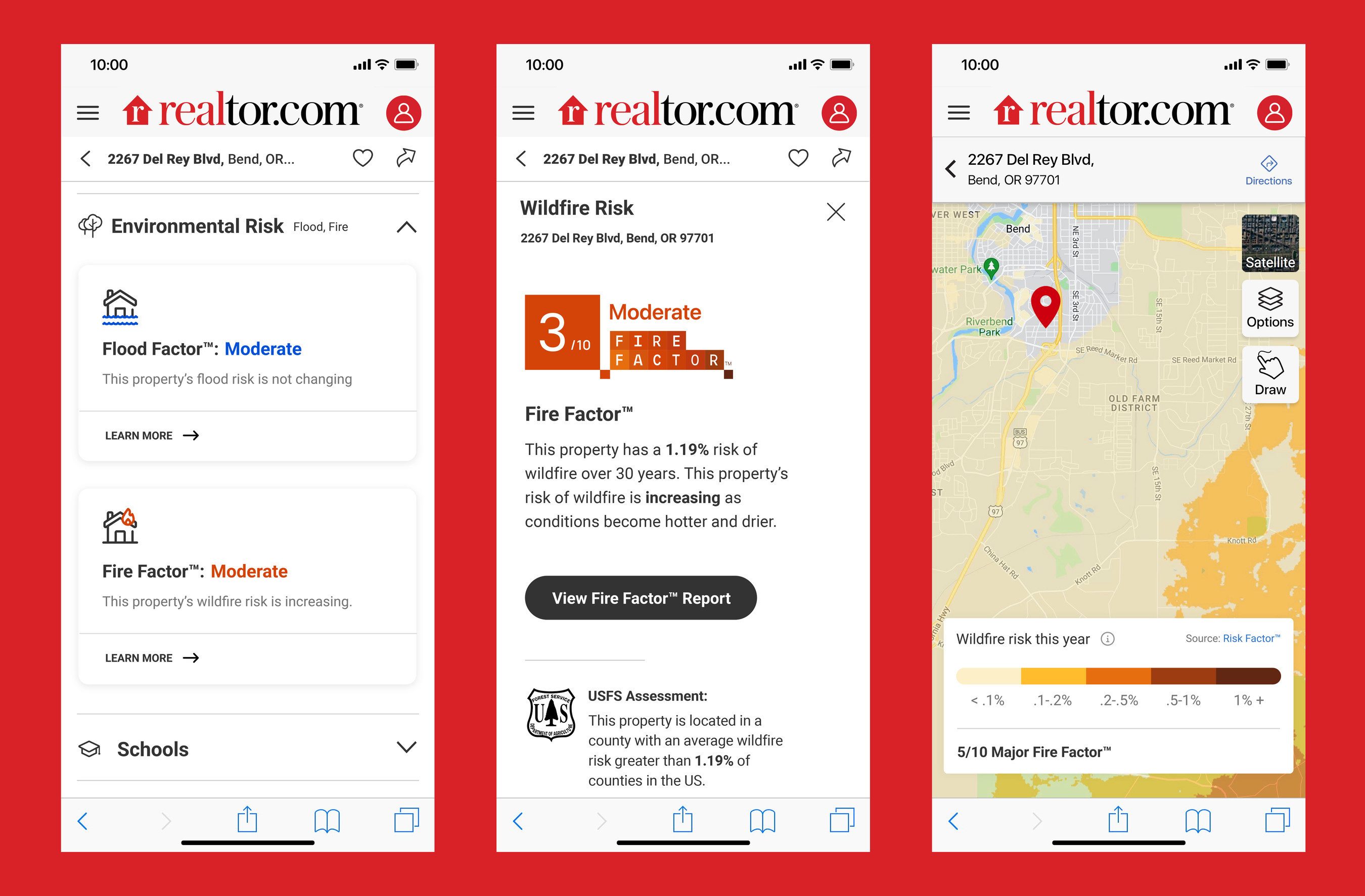
Now, the site has taken another bold step in risk management and mitigation. Realtor.com® announced today that it is adding Fire Factor, an online wildfire risk visualization tool developed by the scientists at First Street, to the valuable information it provides to consumers. I’ve put together answers to some questions I know many of my fellow real estate professionals will be asking about Fire Factor.
Why add Fire Factor? An estimated one in five single-family homes in the U.S. are at risk of being damaged by a wildfire over the next 30 years, according to an analysis by the First Street Foundation. While flooding is the most frequent natural disaster in the U.S. today, recent wildfires in Colorado, California, and now New Mexico; winter storms across the Midwest; and large tornado outbreaks in the South have demonstrated the range of risks facing property owners. In fact, wildfire is the fastest-growing economic climate risk, according to the National Oceanic and Atmospheric Administration. On NOAA’s billion-dollar list of natural disasters, wildfire damage has grown significantly since 1980. The damage in 2020 and 2021 alone surpassed all damage from 1980 to 2000.
How will Fire Factor help consumers? A home is often a family’s biggest asset. However, there isn’t currently a reliable, property-specific source of public information on wildfire risk to help owners and prospective buyers understand potential issues and protect their home. Displaying the First Street Foundation’s Fire Factor model, developed by dozens of fire experts and scientists using data from the U.S. Forest Service and others, will give buyers, sellers, and real estate professionals a distinct advantage. Realtor.com® will also be the only real estate site where people can learn about the wildfire risk specific to each property.
How will Fire Factor help my business? Providing Fire Factor information can help foster trust and confidence during the homebuying and homeselling process. It also provides great value to homeowners, whose improved understanding of fire risk could lead them to take protective measures to reduce risk and potentially realize cost savings of tens or even hundreds of thousands of dollars by avoiding damages.
For sale and off-market properties on realtor.com® will now include Fire Factor, the First Street Foundation’s assessment of wildfire risk.
Why not just use the U.S. Department of Agriculture’s Forest Service website? The U.S. Department of Agriculture’s Forest Service offers government-driven national wildfire risk data at WildfireRisk.org. However, the site is designed for community leaders, not consumers, and intended to compare risk nationally or between states, counties, or communities rather than neighborhoods or specific addresses.
USDA data also doesn’t adjust risk based on more recent fires or changing environmental conditions; their analysis considers only the current risk to homes, exposure type, wildfire likelihood, and vulnerable populations—and it’s strictly based on pre-2014 wildfires. With 45 percent of wildfire damage since 1980 occurring in the last three years, the site’s risk data may be underestimated.
Does highlighting natural disaster risks stigmatize properties? Not in my experience. My business is located in Savannah, Ga., where significant numbers of homes have high Flood Factor scores. My sales did not slow down after this information was added to realtor.com® listings. Flood Factor ensured my clients went into transactions with eyes open. My commitment to giving them the information they needed to make informed decisions helped me build trust. Some of my clients who were initially concerned with higher Flood Factor scores ended up submitting contracts and going to closing because the inclusion of this information prompted the sellers to disclose and explain property improvements they had made to mitigate risk.
How should I answer client questions about Fire Factor? As a real estate professional, I’m a source of property information, not a natural disaster risk expert. I’m always careful to avoid making statements beyond my license and training. I stick to the facts and have contact information for professionals who can answer more detailed questions. Most importantly, I never discourage customers from considering information from credible scientific sources, even if there is uncertainty around data, because more data sources help buyers make more informed decisions.
The U.S. Fire Administration offers useful wildfire statistics that REALTORS® can share with their clients. My colleague Mabél Guzmán, 2022 chair of NAR’s Insurance Committee, created an excellent video on Flood Factor, which is still timely and applicable to wildfire data. And REALTOR® Magazine ran a great article on Flood Factor when it was introduced.
In my experience, Flood Factor has been a welcome addition to realtor.com®, providing my clients the credible, scientific information they need to make informed homebuying decisions. Making this data more accessible is pro-disclosure, pro-transparency, and pro-REALTOR®. This is a great time for realtor.com® to expand its factors to include wildfires and other natural disaster risks.
Just in! April 2022 released from Florida Realtors® detailing recent real estate activity in St. Lucie County. The reports compare year-over-year data. Here are statistics on single family homes.
“St. Lucie County’s median sale price hit $380,000 in April! It seems like every month, our median sale price continues to climb. Meanwhile, inventory levels remain low, which is fueling competition in St. Lucie County. Prospective homebuyers from all around the world are hiring REALTORS® and diving headfirst into a South Florida housing investment. Properties are coming off the market almost as soon as they are listed. Our median time to contract is an astounding 8 days,” said Carlos A. Melendez, President of Broward, Palm Beaches & St. Lucie REALTORS®.
Median Supply of Inventory is a useful indicator of market conditions. The benchmark for a balanced market (favoring neither buyer nor seller) is 5.5 months of inventory. Anything higher is traditionally a buyer’s market, and anything lower is a seller’s market.
“The real estate market grows increasingly competitive each day, which means that having somebody by your side to guide you through the home buying or home selling process is essential. Only a REALTOR® can bring expertise, professionalism and value in more ways than one. Start your home buying journey today by contacting a local REALTOR®,” continues Melendez.
Real estate agents are not just a connection between buyers and sellers. With a REALTOR®, you’re not just getting any real estate agent. You’re getting the expertise of a person who is just as invested in the purchase or sale of your family’s home as you are. Learn more about how REALTORS® are essential to your real estate needs by visiting OnlyARealtor.com.
Broward, Palm Beaches & St. Lucie Realtors® is the 3rd largest local Realtor® association in the nation, representing over 40,000 Realtors®, 41,000 MLS subscribers, and 5 regional boards across South Florida & the Treasure Coast.