Thursday, April 1, 2021

Getting the Right Light


Choosing bulbs has gotten much more complicated as energy-saving technology becomes more common. Here’s how to make the smartest and most flattering choices for a home.


March 18, 2021 by Al DeGenova


Selecting a beautiful new light fixture for a home is a great way to visually update a home and add sparkle to a space. But putting the wrong lightbulb in that fixture can have disastrous effects. The wrong lighting makes a room feel too dark or too bright. Light also affects the appearance of upholstery, paint, or artwork.


Comparing lighting options available today can be like comparing a Model T with a Prius because of the vast options—both old-school and new—on the market. With energy consciousness steadily rising, the expansion of federal legislation mandating lightbulb efficiency is now being reconsidered by the Department of Energy, and some states, including California, Nevada, and Washington, already have strict laws in place. The 60-watt tungsten bulb is, indeed, becoming a Model T.


Just as you can still find gas-guzzling cars, however, you can still purchase incandescent bulbs. However, you need to understand the terminology surrounding new light sources.


Lightbulb Types


LED, CFL, and halogen and tungsten incandescent: LED is the most energy-efficient and long-lasting; it’s also the most expensive. Tungsten incandescent bulbs are the least efficient and cheapest; 90% of the energy consumed by an incandescent bulb is lost as heat. CFLs contain mercury and must be disposed of properly.


Bulbs come in any number of shapes and sizes. When shopping, the most common lightbulb shape and size is described as an “A19 Medium Base.”
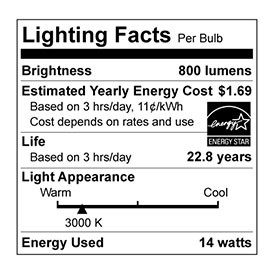


Read bulb labels to find the lighting facts you need.


Brightness: Light output is measured in lumens, not watts as we previously used for brightness. In context, a 60-watt incandescent bulb provides roughly 800 lumens: 40W, 450 lumens; 75W, 1100 lumens; 100W, 1600 lumens; 150W, 2600 lumens.


Energy Used: The amount of electricity that a lightbulb consumes is measured in watts. A 60W tungsten bulb consumes 60W. An 800-lumen LED bulb (equivalent to the 60-watt tungsten) uses approximately 14W of electricity, a 75% reduction in energy consumption. Efficiency is often expressed as lumens per watt; the higher the LPM ratio, the more energy-efficient the bulb.


Light Appearance: We understand lightbulbs described as “warm white” or “bright white,” but these are subjective terms, meaning different things to different manufacturers. Light appearance refers to the “color” of the white light. Light color is represented in Kelvin, a temperature measurement. 2700K is roughly the equivalent of a tungsten bulb; 3000K roughly the equivalent of a halogen bulb; 4500K considered equivalent to daylight, and appears blueish.


2700K lighting is warm and cozy, great for living rooms and bedrooms. 3000K lighting is crisper and best used where functional light is important, as in a kitchen or bathroom. 4000K is great for the garage or laundry room. Make sure that the lamps and ceiling lights in a room have matching Kelvin ratings. Nothing’s worse for a room’s appearance than mismatched light color. A bedroom with 2700K lighting at the ceiling and 4000K in the nightstand lamp looks awkward and will create an imbalance in paint and fabric colors.


Dimming: Ever say, “let’s dim the lights” to create a little romance or watch a movie? When incandescent bulbs are dimmed, their color warms, meaning that it changes to look more like candlelight.


Look for the word “dimmable” as a feature on the lightbulb package or integrated LED fixture. Unlike incandescent lighting, not all LED or CFL lights can be dimmed. This is not a huge consideration for bulbs used in table or floor lamps, but ceiling lights, especially chandeliers, are often controlled by wall dimmer switches. Nondimmable LEDs may not react and CFLs may turn a greenish-blue color. So much for atmosphere.


Further, LEDs and CFLs rated as dimmable will not warm to look like candlelight. They will simply get less bright while giving off the same color. LEDs offer a technology called “warm dim” that mimics the dimming of incandescent bulbs. Search for warm dim LEDs that offer a color range of 3000K to 2200K or wider.


Color Rendering: You probably won’t see the color rendering index of a lightbulb on its package. But this measurement is important when illuminating artwork or when highlighting decor, such as fabrics or paint colors. Low CRI ratings make the colors in a room seem flat, while high CRI makes color snap.


Sunlight, with a CRI of 100, has the most accurate color rendering; halogen matches sunlight with 100 CRI, which is why galleries often use halogen lighting. Most LED bulbs are rated above 85 CRI, which is considered acceptable; CFLs are somewhat lower. However, LEDs are available at higher CRI levels when color rendering is critical.





Wednesday, March 31, 2021

SBA EXTENDS PPP SMALL-BUSINESS LOAN ‘LIFELINE’


Brokers and other smaller U.S. businesses struggling due to the pandemic now have an additional two months to apply for a Paycheck Protection Program (PPP) loan.


If your real estate business continues to feel the effects of the pandemic, you now have an additional two months to apply for a loan through the Small Business Administration’s Paycheck Protection Program (PPP).


By a bipartisan vote of 92-7, the U.S. Senate passed the PPP Extension Act of 2021, which extends the application deadline for a PPP loan through May 31, 2021. It also gives SBA lenders an additional 30 days, through June 30, to process those applications.


The bill passed the House of Representatives March 16, also by a bipartisan vote, 415-3. Since the Senate made no changes to the language of the bill, it goes directly to President Joe Biden for his signature.


National Association of Realtors® (NAR) President Charlie Oppler sent support letters to both the House and the Senate, thanking the cosponsors for introducing the legislation. He also provided a letter of support to the Senate Small Business Committee, which held a March 17 hearing on the performance and impact of the PPP program.


Roughly 20% of NAR members working in residential real estate and nearly 40% of commercial members reported taking out a PPP loan.


“The PPP has been a lifeline for many small businesses, independent contractors, sole proprietors and self-employed individuals since the beginning of this pandemic,” says NAR Senior Policy Representative Erin Stackley. “Many small businesses are mere weeks away from being able to function more normally,” she adds, and PPP funds “could help many cross that finish line.”


Congress appropriated $284.5 billion to the program in the fiscal year 2021 appropriations act passed in December 2020 and an additional $7.25 billion as part of the American Rescue Plan Act, signed by Biden on March 11. It’s estimated that over $110 billion in appropriated funds is still available in the program.


NAR offers more information about the Paycheck Protection ProgramOpens in new tab. on its website.


Source: Florida Realtors®


Tuesday, March 30, 2021

EVICTION MORATORIUM EXTENDED


The Centers for Disease Control (CDC) announced that it is extending its nationwide eviction moratorium through June 30, 2021.


The order was put into place Sept. 4, 2020, but has been challenged in court across numerous states and localities in the months since. In addition to the court challenges, the National Association of Realtors® has fought successfully for federal rental assistance—and will continue to advocate to ensure the moratorium doesn’t lead to a spiraling crisis for housing providers and tenants.


“NAR helped secured $25 billion in 2020 and another $21.55 billion earlier this month in federal rental assistance funding, which can be paid directly to property owners,” says Shannon McGahn, chief advocacy officer of NAR. “This was critical to averting a multifamily real estate crisis, as many of our nation’s housing providers are mom-and-pop operations. Our focus now turns to ensuring there is not just enough funding but also a smooth implementation of rental assistance while the various challenges to eviction bans work their way through the courts.”


Under the terms of the CDC order, residents must declare that they have pursued all appropriate government assistance; met certain income and employment requirements; and are using best efforts to make timely partial payments, among other qualifications. Today’s announcement expands the order to include people “who are confirmed to have, who have been exposed to, or who might have been exposed to COVID-19 and take reasonable precautions to spread the disease.”


Covered persons must now provide their housing provider with a copy of a signed declaration form stating that they meet the requirements to be a “covered person.”  As with previous CDC orders, property owners may still evict tenants due to criminal activity, damaging property, or for violating other contractual obligations.


“Rental assistance averted two crises—one for mom-and-pop property owners who did not have a reprieve from their bills and relied on their rental income and one for tenants who would have been responsible for months of back rent when the eviction moratoriums expired,” McGahn says. “We must continue to look for ways to protect tenants and property owners from further financial turmoil while ensuring housing in America remains safe and stable for decades to come.”


Source: National Association of Realtors®


Monday, March 29, 2021

Hemp is Already Being Used in Walls and Insulation as a Game-Changer in Construction Industry


It has become almost a cliché to discuss the benefits of hemp, the supposed wonder plant with almost endless uses—from woven fibers to edible seeds to bioplastics.  “Of course, hemp is that magic crop that does everything,” says Nicholas Carter, an environmental researcher who, along with Tushar Mehta, a Toronto-based doctor, runs the website Plant Based Data.


His work involves reading through scientific papers and studies and summarizing the most important work supporting plants as a source of food and other important uses. Given the hype, Carter wondered just how much power hemp really had. “I wanted to see the research out there on it, to see what’s actually real, what’s actually backed by evidence,” he says.


Magic? Not exactly. But Carter came away from his attempted debunking a hemp believer. And one of the most promising of its many uses, he found, is its application as a building material known as hempcrete.


Like its namesake concrete, hempcrete is a material mixed with a binder that hardens it into a solid in the form of blocks and panels. Made from the dried woody core of hemp stalks and a lime-based binder, hempcrete can be cast just like concrete.  But unlike concrete and its binding cement, which accounts for about 8% of human-generated carbon dioxide emissions annually, hempcrete actually sequesters CO2. According to a recent study, hempcrete can sequester 307 kilograms of CO2 per cubic meter (19 pounds per cubic foot), roughly the equivalent of the annual carbon emissions of three refrigerators. “While we’re growing it and building hempcrete, it’s sucking CO2 the whole time and encapsulating the CO2 in the structure,” says Eric McKee, founder of the U.S. Hemp Building Association.


S.R. Karade, senior principal scientist of the Central Building Research Institute in Roorkee, India, outside New Delhi, has been studying hempcrete and wrote in a recent paper for the Journal of Cleaner Production about how hempcrete performs as a building material in terms of insulation, durability, structural strength and acoustic control, among other criteria. Overall, Karade found, hempcrete meets the current standards of most building applications and in many cases outperforms materials currently used, particularly for insulation.


Hempcrete is not a direct replacement of concrete, Karade cautions. In the lab he’s been able to make hempcrete with a compressive strength of 3 megapascals (MPa). “Typical concrete blocks, used for making walls, have compressive strength values varying between 5 MPa and 20 MPa,” he wrote in an email. “Due to its poor mechanical strength, it cannot be sufficiently relied upon to undertake any structural loads. However, considering its impressive functional properties, in terms of thermal resistance and [moisture-absorbing] behavior, hemp concrete may be at the top spot in the list of walling materials in the future.”


In other words, it can’t supply the load-bearing structure of a building, but it can insulate and cover its walls.  That’s part of what makes hempcrete such a potentially transformative building material, says Steve Allin, director of the International Hemp Building Association. Not only can hempcrete itself sequester carbon, but its use can help reduce the production of more CO2. “What’s really important about this material is we can create new structures or we can update or retrofit existing structures so that they don’t need air conditioning,” Allin says.


As Karade notes, hempcrete has a high thermal capacity compared with concrete, making it good for both the structure of a wall and its insulation.  Hempcrete can also cut down on another big problem: construction waste. Concrete represents more than half of the debris generated by building construction and demolition. The U.S. Environmental Protection Agency estimates that more than 23 million tons (more than 20 million metric tons) of concrete debris was created during construction in 2015. And while hempcrete can’t be used for structural sections of a building, it can be used to replace non-structural elements of walls that traditionally could use concrete. Hempcrete can also be used in place of common construction materials like drywall and plaster, which account for about 8% of building construction debris.


Allin says builders are beginning to see value in hempcrete. Buildings have been built or renovated with hempcrete in France, the U.K., Belgium, Ireland, the Netherlands, Italy, and Australia. He says the British Science Museum Group’s artifacts storage facility used hempcrete, as have public housing towers and even renovations on stone buildings hundreds of years old.


The challenge, he says, is availability. There are only about a dozen hemp processing plants that are able to process hemp into a form usable in the creation of hempcrete, and most are in Europe, according to Allin. “That’s really the logjam,” he says. “What we really need is investment in primary processing. And that investment needs to be on the longer term, rather than people expecting quick returns and thinking of it as some other standard quick buck.”


Karade notes that the other major challenge is the legality of growing hemp, which can be hard to distinguish from marijuana plants. “The commercial off-take of hemp concrete is still limited by the regulatory constraints of hemp cultivation,” Karade says.


But laws are beginning to change. In the U.S., the 2018 Farm Bill allows for the broad cultivation of “industrial hemp,” but with tight restrictions on grower licenses and the crop’s psychoactive content, tetrahydrocannabinol, or THC.  Allin hopes this will lead to more farmers producing hemp crops and entrepreneurs seeing the opportunity to build the processing plants necessary to turn that hemp into building products. He says builders are willing to use hemp in their projects, but the products have to be available, which relies on the processing, which relies on the farmers. “Once those things are in place, it will all become profitable,” Allin says. “In a way we’re talking about starting an industry from the ground up.”


Share This Story…


Friday, March 26, 2021

Ahh, There You Are Weekend


St. Lucie County


55th annual FIHA Native American Powwow


      • 4-10 p.m. Friday, 10 a.m. to 10 p.m. Saturday, 10 a.m. to 4 p.m. Sunday

      • St. Lucie County Fairgrounds, 15601 W. Midway Road, Fort Pierce

      • Enjoy gourd dancing, intertribal dancing, vendors, tipi display, flute music, hoop dancing, princess competition and Native American food.

      • Admission is $10 per person, $8 in advance and $5 for ages 6-12. Children younger than 6 and active and retired military get in free.

      • fiha.us


      More: Florida’s longest-running intertribal powwow returns


Egg Extravaganza


      • 10 a.m. to 2 p.m. Saturday

      • Savannas Preserve State Park, 2541 S.E. Walton Road, Port St. Lucie

      • Enjoy an educational experience on the Glass Lizard Trail. Signs will prompt visitors along the trail to match pictures of eggs to a list of animals. Activity boxes will be available for pre-purchase for a separate fee of $5 and will be packed with supplies to craft your own animal eggs and nests. The family can work together to build a bird nest, assemble a bundle of snail eggs and help a cluster of frog eggs find their way home.

      • Park admission is $2 per person or $3 per car up to eight passengers.

      • facebook.com/friendsofsavannas


Martin County


24th annual Downtown Stuart Craft Festival


      • 10 a.m. to 5 p.m. Saturday and Sunday

      • Downtown Stuart, 26 S.W. Osceola St., Stuart

      • The best crafters in the nation showcase their paintings, wooden sculptures, ceramics, jewelry and handmade baskets. It also includes a green market with plants, dips and homemade soaps.

      • Free admission

      • artfestival.com/festivals/stuart-craft-fair


Indian River County


61st annual Easter Egg Hunt


      • 10-11:30 a.m. Saturday

      • Mulligan’s Beach House, 1025 Beachland Blvd., Vero Beach

      • Children ages 9 and younger can participate in the beachside hunt. Enjoy a visit from the Easter Bunny. Lucky participants will find one of the coveted golden eggs, but every child gets a prize. Bring a donation of six empty eggs.

      • Free admission

      • facebook.com/verobeachmulligans


Central’s Spring Festival


      • 10 a.m. to 2 p.m. Saturday

      • Central Assembly of God, 6767 20th St., Vero Beach

      • Enjoy inflatable activities, crafts, pony rides, petting zoo, food, refreshments, photo booth fun and an egg hunt for children ages 11 and younger. Egg hunt schedule is 11 a.m. for ages 3 and younger, 11:30 a.m. for ages 4-5, noon for ages 6-8 and 12:30 p.m. for ages 9-11.

      • Free admission.

      • centralassembly.com


Thursday, March 25, 2021

Inventory Crisis Pushes Down Existing Home Sales


Following months of sharp gains, existing-home sales reversed course in February, falling 6.6%, the National Association of REALTORS® reported Monday. However, the dip—precipitated by a persistent inventory crunch that’s getting worse—isn’t necessarily a significant drag on the real estate market, says NAR Chief Economist Lawrence Yun. “The market is still outperforming pre-pandemic levels,” he says.


Despite the supply challenges, all four major regions of the U.S. posted year-over-year sales gains in February, according to NAR. Total existing-home sales—completed transactions that include single-family homes, townhomes, condos, and co-ops—fell to an annual rate of 6.22 million in February. Sales are still up 9.1% compared to a year ago.


Yun cautions that a slowdown in sales growth over the coming months is possible as home prices and rising mortgage rates chip away at housing affordability. “I still expect this year’s sales to be ahead of last year’s, and with more COVID-19 vaccinations being distributed and available to larger shares of the population, the nation is on the cusp of returning to a sense of normalcy,” Yun says. “Many Americans have been saving money, and there’s a strong possibility that once the country fully reopens, those reserves will be unleashed on the economy.”


Here’s a closer look at key indicators from NAR’s latest housing report.


      • Home prices: The median existing-home price for all housing types was $313,000 last month, a 15.8% jump compared to a year earlier. Prices rose in every major region of the U.S. annually, led by a 20.6% and 20.5% gain in the West and Northeast, respectively. The Midwest saw a 14.2% increase, and the South posted a 13.6% increase in annual prices.

      • Housing inventory: The number of homes for sale continued to decrease in February, down nearly 30% compared to a year earlier. Unsold inventory now sits at just a two-month supply at the current sales pace.

      • Days on the market: Seventy-four percent of homes sold in February were on the market for less than a month. Properties typically stayed on the market for 20 days in February, down from 36 days a year prior.

      • First-time buyers: First-time buyers comprised 31% of sales in February, down slightly from 32% a year earlier.

      • All-cash buyers: All-cash sales accounted for 22% of transactions in February, up from 20% a year ago. Individual investors and second-home buyers accounted for the biggest bulk of all-cash sales and purchased 17% of existing homes in February.


Regional Breakdown


The only region to see a month-over-month uptick in home sales last month was in the West. Here’s a closer look at how existing-home sales fared across the country in February, according to NAR’s report:


      • Northeast: Existing-home sales dropped 11.5% in February to an annual rate of 770,000, a 13.2% increase from a year ago. Median price: $356,000, up 20.5% from February 2020.

      • Midwest: Existing-home sales fell 14.4% to an annual rate of 1.31 million in February, still 2.3% higher than a year ago. Median price: $231,800, a 14.2% climb from February 2020.

      • South: Existing-home sales dropped 6.1% to an annual rate of 2.77 million in February, still 9.9% higher than a year ago. Median price: $271,200, a 13.6% increase from February 2020.

      • West: Existing-home sales increased 4.6%, reaching an annual rate of 1.37 million, up 12.3% from a year ago. Median price: $493,300, up 20.6% from February 2020.


Wednesday, March 24, 2021

ST. LUCIE COUNTY MEDIAN PRICE HITS $275,000 IN FEBRUARY


Just in! Newly released market reports from Florida Realtors® detailing recent real estate activity in St. Lucie County. The reports compare year-over-year data for February. Here are statistics on single family homes.


“We have a new high in median sale price for St. Lucie County! In February, the median sale price rose 17 percent year-over-year to $275,000. Homeowners should be optimistic as their home values continue to reach new levels. Just like we did in 2020, we’re seeing a steady streak of the median price outperforming the previous year,” said Karen Johnson, President of Broward, Palm Beaches & St. Lucie Realtors®.


Median sale price is our preferred summary statistic for price activity because, unlike average sale price, median sale price is not sensitive to high sale prices for small numbers of homes that may not be characteristic of the market area.


“The current inventory levels are the lowest we’ve seen in the past year with the months’ supply of inventory decreasing 55.3 percent to 1.7 months. What we’re seeing in our market is a vast decline in inventory levels which is leading to more buyer competition in the market. It’s a great time to invest in the real estate market as Florida continues to expand the vaccine eligibility and more Americans seek all that our state has to offer. If you have questions on the current market conditions or the home buying and selling process, contact a local Realtor® today for their expertise,” continues Johnson.


Months’ supply of inventory is a useful indicator of market conditions. The benchmark for a balanced market (favoring neither buyer nor seller) is 5.5 months of inventory. Anything higher is traditionally a buyers’ market and anything lower is a sellers’ market.


Market Reports: St. Lucie Single FamilyOpens as PDF. | St. Lucie Townhouses/CondosOpens as PDF.