Thanks for visiting our blog, where we guarantee you'll find plenty of helpful information to assist you in purchasing your new home or refinancing your current mortgage.
We also like to post technology and local interesting news.
Enjoy!
There has been a recent wave of lawsuits filed against Realtors® by testers.
There has been a recent wave of lawsuits filed against Realtors® by “testers,” which are groups that call Realtors® just to see if the Realtor® will violate a provision of the Fair Housing Act (FHA), even though the tester has no relationship with the Realtor® and is not interested in buying or renting the listed property. Courts have found that these testers have standing to sue as they have suffered injury.
Recent attention has been placed on the Housing Choice Voucher Program or “Section 8” vouchers. Several municipalities in Florida, including Broward County, have adopted laws prohibiting housing discrimination based on source of income. This means that it is illegal for a housing provider to keep a person out simply because that person is paying for housing with a subsidy or assistance like Section 8, or other benefits programs. If you receive an inquiry from a consumer asking about Section 8 vouchers or any Fair Housing provisions – a best practice response is to inform that caller that they are free to submit an application to lease/offer to purchase the property and that the landlord/seller makes all decisions regarding the lease/purchase of the property. Check your local ordinance for additional details and any relevant exemptions.
This is an evolving issue. Realtors® must be aware of and stay up to date on Fair Housing laws, in addition to the Florida Civil Rights Act, so they don’t face lawsuits.
Source: Florida Realtors®, Broward County, Florida Code of Ordinances, Chapter 16½.
Home repair grant funds available to low-income PSL residents
Qualified City residents in need of home repairs soon will be able to apply for funds to pay for these projects after Port St. Lucie was awarded the largest State Housing Initiative Partnership (SHIP) grant in its history.
The City of Port St. Lucie received $3 million, courtesy of the SHIP grant, awarded by the Florida Housing Finance Corporation. The City will allocate this funding for the PSL’s Homeowner Repair and Rehabilitation Assistance Program.
Port St. Lucie’s Neighborhood Service Housing Division will open the Homeowner Repair and Rehabilitation Assistance Program pre-application list at 9 a.m. Monday, Oct. 3, 2022, and the list will remain open until the maximum number of applications (60) has been reached.
Port St. Lucie’s Homeowner Repair & Rehabilitation Assistance Program is designed for low-income homeowners who need assistance to fund approved repair and rehabilitation projects for their primary residence. To apply, applicants must:
Be low-income
Have had their primary residence within Port St. Lucie for one year or more
Have an assessed home value of $358,308 or less
Be protected by a homeowner’s insurance policy
Be current on any mortgage payments
The City will provide up to $50,000 for approved home repairs for income-eligible homeowners. This program will provide 0% interest deferred payment loans (DPL), meaning no monthly payments are due, for health/safety/energy efficiency home improvements. The loans are forgiven over a 15-year period, according to the program guidelines.
These funds are utilized to make necessary improvements to ensure homes are safe, sanitary and meet current code requirements. Eligible repairs include correcting code violations, weatherization, roof, plumbing and electrical improvements, septic systems, etc. Manufactured homes, pool/hot tubs and illegal/non-permitted repairs or remodeling do not qualify. Applicants can view a list of frequently asked questions and more information about the program guidelines online at www.cityofpsl.com/housing.
Beginning 9 a.m. Monday, Oct. 3, 2022, interested and qualified persons can begin the process by filling out the required pre-application questionnaire at www.cityofpsl.com/housing. If an applicant cannot access the pre-application online, they may call the City to have someone assist them or come into City Hall for a printed copy. The City’s Neighborhood Services Department, Community Programs Housing Division, is available to answer questions, print a pre-application or review any of the questions with applicants by:
In-person: City Hall, 121 SW Port St. Lucie Blvd., from 9 a.m. to 4 p.m., Monday through Friday.
Applicants who apply and meet all the eligibility criteria will be notified by City staff about the status of their application and any future steps in the processing of their file by telephone and/or email (if applicable).
When the maximum number of applications has been received, the City will publish a notice on www.cityofpsl.com/housing that the pre-application list has closed. The 60 applicants on the list will be processed in the order they are received. If additional funding is available, the City will re-open the pre-application list and notify residents at least two weeks before opening.
Just in! August 2022 released from Florida Realtors® detailing recent real estate activity in St. Lucie County. The reports compare year-over-year data. Here are statistics on single family homes.
“Housing inventory continues to rise in St. Lucie County! We’re starting to see supply levels improve with the help of increasing interest rates and inflation. In August, active inventory rose by 124.4 percent to 1,625 listings, and supply of inventory increased 125 percent to 2.7 months,” said Carlos A. Melendez, President of Broward, Palm Beaches & St. Lucie Realtors®.
Inventory is the number of property listings that are active at the end of the month. Meanwhile, months’ supply of inventory is an estimate of the number of months it will take to deplete the current inventory given recent sales rates.
“Sellers, don’t let rising inventory levels deter you from listing your property. Yes, we have more supply entering the market, but St. Lucie County is still seeing intense competition among buyers. Our area is one of the most sought-after regions to purchase real estate in the country, and we see that through median home prices rising again with an increase of 22.7 percent to $390,000. Contact a local Realtor® today — they are the market experts and will serve as your advocate in the home buying or selling process,” continues Melendez.
Green is in when it comes to design, especially amongst the younger buying pool, and staircase gardens provide a unique, aesthetically pleasing look for those who want a touch of nature.
Staircases serve an important function both in and out of homes, but their ability to add aesthetic value to a space often goes unrealized. As the desire to bring nature into the home has increased in recent years, homeowners have found a new purpose for these transitional features: staircase gardens. Evoking whimsy, staircases adorned with potted plants or trailing vines add a pop of vibrancy and life to an otherwise overlooked space.
According to Pinterest’s trending searches, interest in staircase gardens is on the rise. Gardening and interest in houseplants, especially by millennials, have both experienced a boom during the pandemic as people have spent more time at home. All that time at home has also allowed people to look at spaces that don’t get used beyond their function, including staircases, but people are bringing them back into the fold using plants. “I think that they may be looking again at their spaces because they’ve been spending more time in their home environments,” says Mary Barensfeld, a Pittsburgh-based architect. “I think there’s something that draws people toward nature, whether that’s going for spending time outdoors or bringing nature into the home and working amongst nature.”
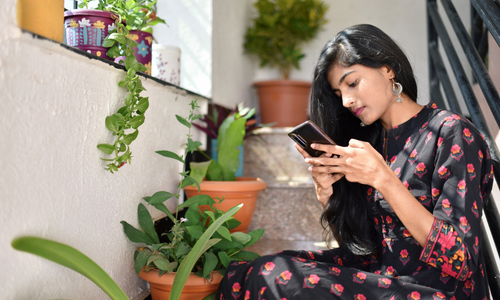
Mayur Kakade / Getty
Adding plants to a staircase offers a pop of green and a dose of nature.
Adorning staircases with greenery does more than create a cool vibe. It also encourages passersby to momentarily pause and acknowledge the space around them. “Anytime you have a plant somewhere as you walk by, you’re checking on it, right? To see if it needs any water, there’s a new leaf there that you didn’t notice last week,” says Maryah Greene, a plant stylist and founder of Greene Piece. “I love to put plants in any space where mindfulness can be entered into the equation, and stairs are a great place to do that as you move throughout your day,” she says. “It’s just a moment to check in on your space.”
A staircase garden might sound daunting, but can easily be created with just a couple of plants. Here’s what to know if your clients want to add a staircase garden to their homes.
Look Under the Stairs
Sometimes staircases have leftover space underneath that is open but not quite usable for anything else. “It’s a perfect spot to fill with something that doesn’t have the knickknack-y vibe, but it’s a good place to put plants,” says Barensfeld. These spaces receive less natural light, so consider shade-loving plants, like snake plants or maidenhair ferns, and make sure the plants can be easily watered.
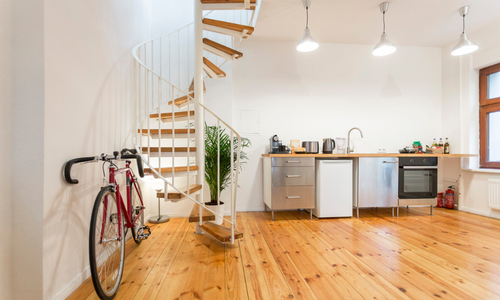
Westend61 / Getty
One tall plant makes a big difference underneath a staircase, where little else might fit without creating clutter.
DigitalStorm / Getty
For larger under-staircase spaces, a mini-atrium adds a bold statement of green.
The type and number of plants used under stairs will depend on the size of the space. A single, tall plant might work well for a space that’s small but possesses a decent height. Likewise, in larger spaces, adding more than one plant—or even a mini-atrium of plants—adds a bold statement while still embodying a minimalist look. If the staircase is a focal point in the home, plants help dress it up.
Use a Trailing Plant
Greene advises homeowners to keep stairs as clear as possible—no one wants to trip on a plant. Using a trailing plant to wrap around the railing of the stairs leaves the staircase open while also creating a beautiful space. Picking just a couple of plants that are “super long and vine-y” creates the illusion of “having this lush jungle on your staircase, but it’s only a couple of plants that are just really long,” says Greene.
Plants that typically work best for this include philodendrons, golden pothos and mini monstera (rhaphidophora). To execute this, homeowners should place a plant at the top of the stairs and let it trail down, shaping the plant around the railing. They can also place one plant at the top of the stairs and one at the bottom and have them meet in the middle, which works if the plants are really long.
Westend61 / Getty
Vine-y plants make great assets to stairs.
The best way to encourage length, Greene says, is to find the source of light. “If, on the bottom floor, you have a window, but on the top floor, it’s a bit darker up there, I recommend having that plant in the spot that’s the sunnier so that it can continue to grow, as opposed to having it at the top of the stairs, where there is no sunlight—that plant’s really going to struggle to grow downward,” she says.
Trailing plants work well for outdoor staircase gardens, too. For this locale, planting the vines in soil is key, advises Brandy Hall, founder of Shades of Green Permaculture. “They’re going to be less finicky because they have contact with the soil,” says Hall. “They’re going to get water, and they’re going to get nutrients. You don’t have to really think about them as much as you do with containers.” Plants like creeping figs are great to train against closed risers, while muscadines and evergreen clematis can work great with railings, depending on the conditions.
Keep Pot Size in Mind
As tempting as it may be for homeowners to arrange potted plants on their staircases, it’s important to remember to keep the steps as clear as possible. It can be done, though, if pot size is taken into consideration.
When plants come home from the plant shop, they should ideally be repotted into a container that’s an inch or two bigger than the nursery pot, says Greene. A pothos in a four-inch pot at the nursery, for example, should go into a six-inch pot at home. “You want to figure out the diameter of your steps and make sure that pot isn’t taking up way too much space on your stairs to prevent you from using those stairs,” says Greene. “Start smaller than you think, because plants grow, of course, and so as that plant continues to grow, you’re eventually going to pot it into something bigger every couple of years.”
Barry Winiker / Getty
Make sure to keep the path clear on the stairs to avoid accidents by keeping pot size in mind.
Another cool way to use potted plants is to consider the WallyGrow planter system, which allows users to create plant walls with various hanging planters. “Their main focus is allowing you to create a living wall, or a live plant hanging anywhere in your home. I’d definitely recommend those; they’re awesome, they make watering easy. If you have hardwood floors, you’re not ruining those,” says Greene. They can be arranged on the wall along a staircase, leaving the railings and stairs clear.
Get Colorful
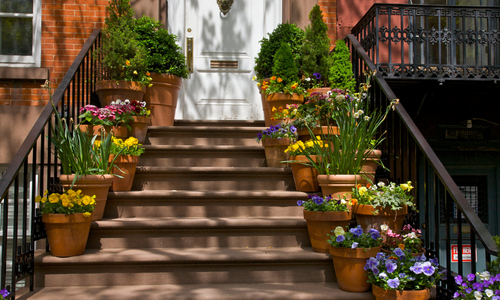
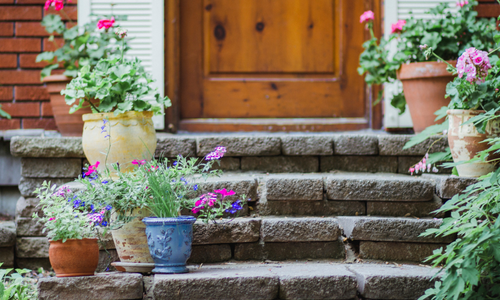
While green houseplants work well for indoor staircases—and some do have flowers or colorful leaves—outside staircases are great spaces to introduce pops of color. Homeowners can carefully arrange potted annual flowers to create a lively space. “I really love using bunching grasses in outdoor containers, because they have a lot of seasonal interest and they overwinter really well, even though they don’t stay green year-round,” says Hall.
Potted flowering plants add pops of color to an outdoor staircase.
Bunching grasses like chasmanthium and river oats are especially great for this purpose. “They have really beautiful seed heads in the fall, and then they’ll stay golden during the winter and then come back to life in the spring,” says Hall.
With younger home buyers trending green and showing an uptick in interest in houseplants and gardening, staircase gardens are a great and relatively easy way to meet demand and bring the outdoors in or simply to dress up an underutilized space. They’re also a great tool for staging or helping your client set up their space once they’ve purchased a home.
Lia Picard – Lia Picard is a lifestyle journalist based in Atlanta. Interior design is one of her main beats, including the spaces themselves and the people and trends of note in the industry. Her work appears in the New York Times, the Wall Street Journal, the Washington Post, and other national and regional outlets. Follow Lia and her work on Instagram @LiaPicard.
At NAR’s iOi Summit this month, the annual Pitch Battle will aim to identify the next great innovation to help your business flourish.
Twelve technology startups in the real estate space with new offerings such as fractional ownership, home renovation and rental solutions are poised to shake up the real estate industry. These budding companies will take the stage later this month at the National Association of REALTORS®’ 2022 Innovation, Opportunity & Investment Summit in Los Angeles, competing in a “Shark Tank”–style Pitch Battle for crucial funding to widen their reach.
Each of the preselected companies will showcase their innovations live in a four-minute pitch about their product or service and how it can improve the real estate industry. Each company also will face a rapid-fire question-and-answer session from a panel of judges. The winner of the Pitch Battle will receive $15,000 and booth space at NAR’s annual conference in November, “NAR NXT, The REALTOR® Experience.”
“In today’s real estate ecosystem, innovation is accelerating, opportunity is exploding and investment is at a record high,” says NAR CEO Bob Goldberg. “At the iOi Summit, real estate professionals, investors and innovators gather to cultivate and champion the most impactful ideas that will disrupt the status quo and advance the industry.”
Second Century Ventures, NAR’s venture capital arm, hosts the Pitch Battle at the iOi Summit, which is being held on Sept. 28 and 29. The annual competition aims to help new property tech companies gain a foothold in the real estate space. These are this year’s Pitch Battle contestants:
Agently: An AI-powered coaching platform for real estate agents. It provides daily guidance and tools and offers results-driven action plans.
Arx: An automated underwriting and market intelligence platform for real estate developers and brokers. It helps pros source and evaluate real estate projects in minutes.
CubiCasa: An app for creating floor plans. Use an iOS or Android device to capture an indoor space in five minutes to create a more visual look for potential buyers.
Fractional: A social platform for co-investing in properties, sharing ideas and building a network. It helps people to co-own real estate with friends and other like-minded investors.
Inspectify: It connects real estate professionals and home buyers with qualified inspectors in their area to streamline the booking process. Schedule appointments in minutes and have direct communication using the latest technology.
Pacaso: It aims to make second-home ownership more accessible by lowering ownership costs and reducing hassle through fractional ownership opportunities. It provides a fully managed owner experience in fractional ownership transactions.
Prisidio: A secure, cloud-based vault that’s housed in one location, allowing users to share their valuable and important documents, such as birth certificates and insurance policies, only with those they trust. It’s simple, mobile and secure.
RentBase: Helps residential real estate agents by providing an interconnected bird’s-eye view of their property providers, listings and leads. Agents can access all of their data and automatically qualify and match leads to listings. They can also use it to maximize cashflow by leveraging the technology to uncover new opportunities.
Residently: A digital property rental platform that helps renters find their next home months in advance of a move. Use it to view key property documents, contracts, and essential home information, like building access codes.
Revive: A home renovation consultant that helps homeowners strategically repair and renovate their homes before selling to significantly increase their net gains. It assists homeowners with maximizing the value of their homes with no upfront costs.
Stake: The platform seeks to modernize investing in real estate for the average person. Stake aligns incentives between residents and owner-operator groups that are driven by residents’ actions. Incentivizes actions with cash back for the residents, empowering them to act on their financial journey.
Symba: A financial well-being tool made for real estate agents. It combines customer relationship management with banking and offers tools for customer support, managing deals and making financial decisions.
Real estate professionals are deepening their involvement in giving back to the communities, according to a new NAR report.
REALTORS® are building deep connections within their communities, giving more money and devoting more time to support numerous causes from neighborhood cleanups to fundraising for those in need. Eighty-three percent of the nation’s 1.5 million REALTORS® cite community involvement as an important component of their business plan, according to the National Association of REALTORS®’ newly released 2022 Community Aid and Real Estate (CARE) Report. The report highlights the monetary contributions and volunteer efforts of NAR members, broker-owners and REALTOR® association executives and staff.
Two-thirds of REALTORS® say they volunteer on a monthly basis, spending an average of eight hours per month giving back, the report shows. Further, 79% made charitable donations last year. REALTORS® were most likely last year to volunteer to deliver food to the elderly or help food banks with COVID-19 relief efforts, according to the report. Twenty-two percent of REALTORS® say they hosted an annual fundraiser for their local community or nonprofits.
“REALTORS® are deeply involved in their communities, and this report shines a light on the great volunteer efforts by NAR members,” says NAR President Leslie Rouda Smith. “It is inspiring to see REALTORS® across the country continue to boost local charitable efforts, and I’m proud to be part of such a compassionate and caring group.”
Associations Encourage More Members to Get Involved
Charitable giving by REALTOR® associations has climbed 20% since 2020, the report shows. The typical REALTOR® association donated more than $12,000 to the community last year, up from $10,000 in 2020. Eighty-five percent of associations hold events that encourage their members to volunteer within their community, according to the report. At least half of the nation’s local and state REALTOR® associations planned volunteer projects for the week-long 2022 REALTOR® Volunteer Days event in June.
For example, Florida REALTORS® recently held a volunteer event called “Clean Up Florida’s Waters,” in which members across the state teamed up to clear more than 18,000 pounds of trash and debris from 36 miles of Florida waterways.