Wednesday, April 20, 2022

Homeowner Groups Try To Block Investor Buying Sprees


Homeowner associations across the country are rewriting rules to try to prevent investors from purchasing housing in their neighborhoods, The Wall Street Journal reports. Some homeowner association groups are concerned that an uptick in homes purchased by investors could lead to a decline in property maintenance and make their neighborhoods less desirable. They also argue that investors are preventing more families from being able to buy houses.


Homeowner associations believe they have the power to stop them. As such, some housing groups are attempting to cap the number of homes that can be rented out in a neighborhood. They may require rental tenants to be approved by the association’s board.


One such move was taken in Walkertown, N.C., where the Whitehall Village Master Homeowner Association is trying to amend its rules to require that new buyers live in a home or they must leave it vacant for six months before they can rent it out. That would prevent investors from purchasing any more homes in the neighborhood.


“They’re coming in and they’re basically bullying people out with cash offers,” Chase Berrier, the association’s president, told The Wall Street Journal about the movement.


In Fishers, Ind., a town of about 100,000, more than 900 homes were purchased by non-owner occupants between 2016 to 2021. About one-third of the home purchases were from out-of-state investors, The Wall Street Journal reports. The mayor of the town says it’s “denying an entire group of individuals an opportunity to build equity” in the town by being shut out by investors.


Trying to capture the hot housing market, investors have increased their buying activity. Single-family rentals have become a huge growth area, too. More than one in five home sales in December 2021 were investor purchases, according to CoreLogic housing data.


As more homeowner associations take steps to try to ban renters, investors aren’t happy. The homeowner associations’ actions also are attracting lawmakers’ attention in many states as they debate how much power homeowner associations should have in limiting renters in their neighborhoods.


“The only real purpose of restricting rentals in a given community is to keep renters out, actions which in our view are both harmful and dangerous,” David Howard, executive director of the National Rental Home Council, told The Wall Street Journal.


Tuesday, April 19, 2022

3 Easy Houseplants Can Instantly Reduce Air Pollutant by Up to 20%


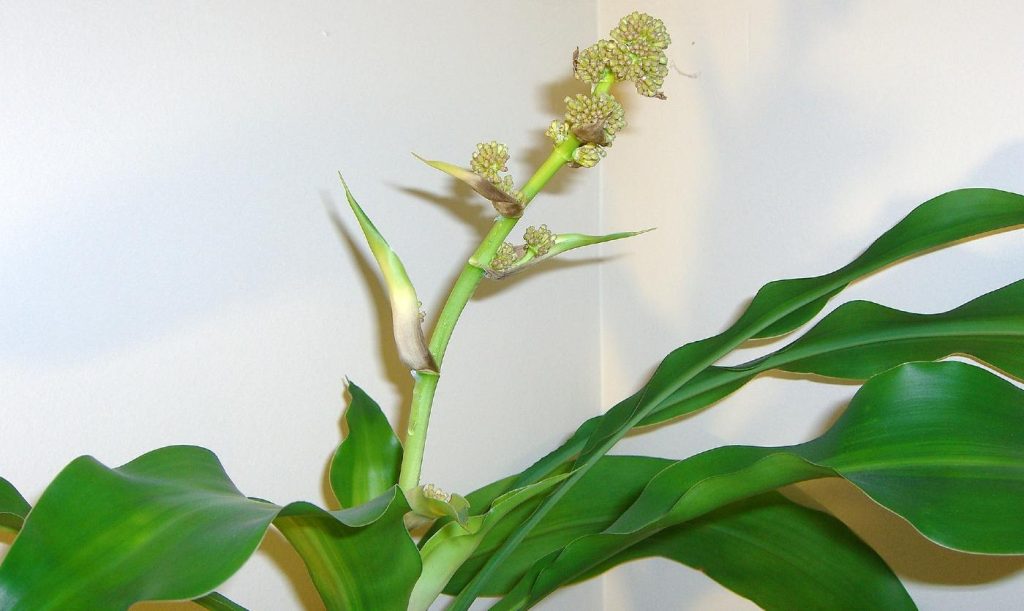
Corn plant (Dracaena fragrans); Massangeana, CC license

Ordinary potted house plants can potentially make a significant contribution to reducing air pollution in homes and offices.


That’s according to new research led by the University of Birmingham and in partnership with the Royal Horticultural Society (RHS).


During a series of experiments monitoring common houseplants exposed to nitrogen dioxide (NO2)—a common pollutant—researchers calculated that in some conditions, the plants could be able to reduce NO2 by as much as 20 percent.


Each plant was put, by itself, into a test chamber containing levels of NO2 comparable to an office situated next to a busy road.


Over a period of one hour, the team calculated that all the plants, regardless of species, were able to remove around half the NO2 in the chamber. The performance of the plants was not dependent on the plants’ environment, for example whether it was in light or dark conditions, and whether the soil was wet or dry.


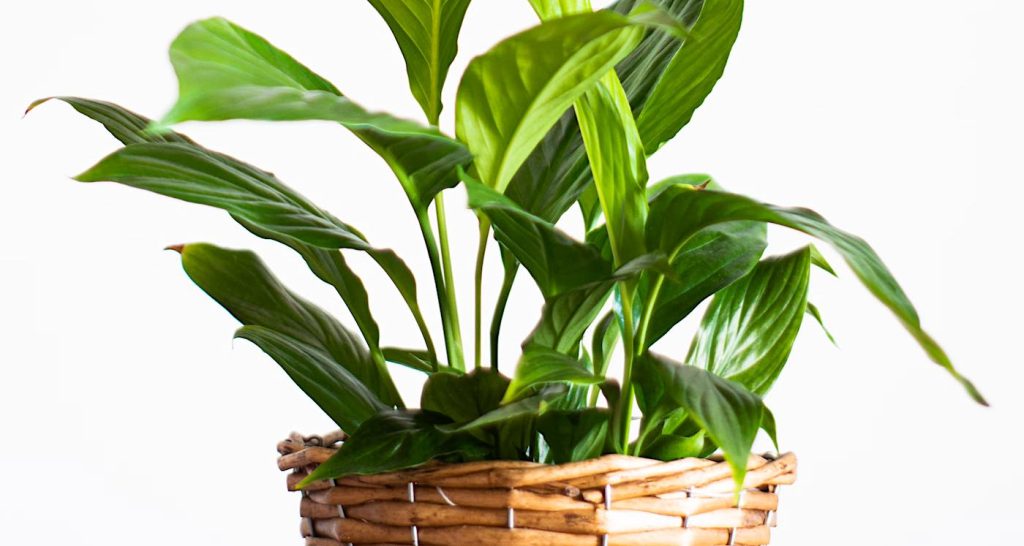
Peace Lily (Spathiphyllum wallisii) by Rui Silvestre

Peace lily W.carter, CC license

Lead researcher Dr Christian Pfrang said, “The plants we chose were all very different from each other, yet they all showed strikingly similar abilities to remove NO2 from the atmosphere. This is very different from the way indoor plants take up CO2 in our earlier work, which is strongly dependent on environmental factors such as night time or daytime, or soil water content.”


The team also calculated what these results might mean for a small office (15 m3) and a medium-sized office (100 m3) with different levels of ventilation. In a poorly ventilated small office with high levels of air pollution, they calculated that five houseplants would reduce NO2levels by around 20 per cent. In the larger space, the effect would be smaller— 3.5 per cent, though this effect would be increased by adding more plants.


There was no indication, even during longer experiments, that our plants released the NO2 back into the atmosphere, so there is likely a biological process taking place also involving the soil the plant grows in—but we don’t yet know what that is.”


Dr Tijana Blanusa, principal horticultural scientist at the RHS and one of the researchers involved in the study said, “This complements RHS efforts to understand scientific detail behind what we know to be a popular passion. Understanding the limits of what we can expect from plants helps us plan and advise on planting combinations that not only look good but also provide an important environmental service.”


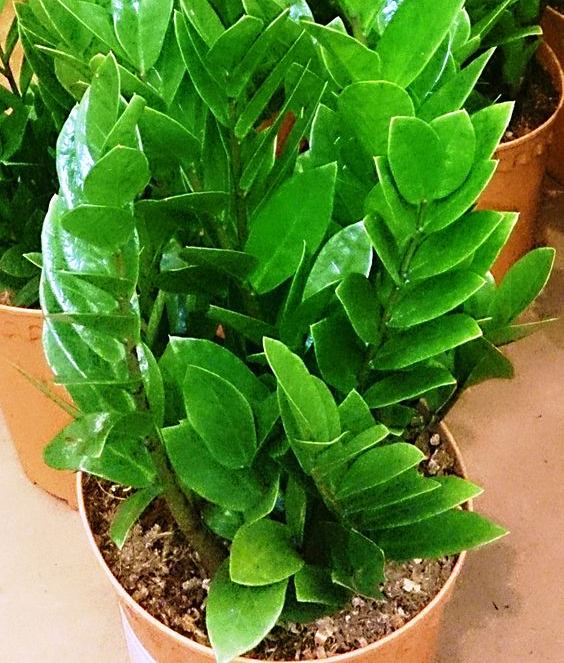
Fern arum (Zamioculcas zamiifolia); Mokkie, CC license

In the next phase of the research, the team will be designing sophisticated tools for modelling air quality indoors encompassing a much wider range of variables.


The new project, funded by the British Met Office, will use mobile air quality measuring instruments to identify pollutants and test their effects in both residential and office spaces, producing a wealth of data to inform the tool’s development.


All in all, it sounds as though—if you haven’t yet joined in on the potted plants trend, maybe it’s time you tried?


This research has been published in Air Quality, Atmosphere & Health.  / Source: University of Birmingham


Monday, April 18, 2022

US home prices are rising so fast, property taxes can't keep up


With home prices skyrocketing by double-digit percentages over the last year, it would be no surprise if property taxes jumped too.


ut surprisingly, the average property tax on a single-family home rose by just 1.8% last year to $3,785, increasing at the smallest pace in the past five years, according to a report from ATTOM, a real estate data company. That has resulted in an effective tax rate of 0.9%, down from 1.1% in 2020, the report found.

But this small silver lining in the housing market may not last long. Home prices may have risen so fast that taxes are still catching up, said Rick Sharga, executive vice president of market intelligence at ATTOM.


“It’s hardly a surprise that property taxes increased in 2021, a year when home prices across the country rose by 16%,” Sharga said. “In fact, the real surprise is that the tax increases weren’t higher, which suggests that tax assessments are lagging behind rising property values, and will likely continue to go up in 2022.”


That means bigger jumps in property taxes could be coming in years ahead.


In 2021, effective tax rates — a measure of taxes relative to a home’s value — declined, even as total taxes rose because home values went up much more quickly than taxes did, the report found.


Home values spiked by more than 10% in many markets across the country. Property taxes that are still lagging behind these spikes in prices should be something for new buyers to keep in mind.


“Prospective homeowners often fail to include property taxes when considering the cost of homeownership,” Sharga said. “But, especially in some of the higher-priced markets across the country, property taxes can add thousands of dollars to annual ownership costs, and possibly be the difference between someone being able to afford a home or not.”


Who pays the highest property taxes


New Jersey’s average tax of $9,476 on a single-family-home was the highest in the country last year. It was about 10 times more than the average of $901 in West Virginia, which had the nation’s smallest average tax.


Other states with the biggest average tax bills were Connecticut at $7,464, Massachusetts at $6,777, New Hampshire at $6,698 and New York at $6,617.


Rounding out the bottom five were Alabama at $905, Arkansas at $1,195, Mississippi at $1,243 and Louisiana at $1,248.


Last year, the states with the highest effective tax rate — the average annual property tax as a percentage of the average estimated market value of homes in each area — were Illinois, New Jersey, Connecticut, Vermont and Pennsylvania.


At the city level, most of the highest taxes were paid by residents of Northeastern and Midwestern metro areas.


Looking at cities with more than 1 million people, Rochester, New York, had the highest effective tax rate of 2.22%, followed by Hartford, Connecticut; Chicago; Philadelphia and Cleveland.

Among places with the lowest effective rates were Honolulu; Montgomery and Tuscaloosa, Alabama; and Prescott, Arizona.


The report analyzed property tax data collected from county tax assessor offices nationwide, along with estimated market values of single-family homes determined using an automated valuation model.


Friday, April 15, 2022

Upcoming Events This Weekend


Protect Your A/C Unit and Beat The Heat Lecture


St. Lucie County

Date: 15th of every month.

Time: 10:00 am – 12:00 pm

Location: St Lucie AC Repair Pros HQ

Address: 145 NW Central Park Plaza #199 Port St. Lucie, FL 34986

Price: FREE

Category: Community


St Lucie AC Repair Pros invites you to an ongoing series of special lectures. We will be discussing the current problems of air conditioning and heat issues in Port St Lucie. We will talk about how to prevent common problems, and how to properly give maintenance to your A/C unit. Join us as we interact, share ideas and special tips.


****************************************


Good Friday Art Show “MARY & JESUS”


Date: Friday April 15, 2022

Time: 4:00 pm – 7:00 pm

Location: RCK Gallery

Address: 614 South Colorado Ave., Stuart, Florida 34994

Price: FREE & OPEN TO THE PUBLIC

Category: Arts / Exhibits


Robert Clay Kanzler will be displaying a remarkable grouping of original oil paintings on Good Friday, April 15TH between 4-7 PM.

The powerful exhibition titled “Mary & Jesus” is FREE & OPEN TO THE PUBLIC.

Read what one viewer had to say about his experience with the exhibition:I recently had the decided good fortune to view Clay Kanzler’s ” Mary & Jesus” exhibit at the new and warmly received RCK Gallery in Stuart. I realized upon entering that there was a palpable atmosphere of contemplation in every corner of the gallery. I noticed a very still and quiet observer with wet eyes on the verge of release…with good reason. I sensed I would be joining her soon, and indeed I did.

There are a multitude of layers in every piece of art that Clay gives to the world. His works are traditionally large format because the heart rendered emotions that appear on the canvas are mined from an infinite vein. Clay uses his art to help him understand trials, trauma, and tragedy that cross his path. He does so unselfishly and without limitations. He does so with the unexpressed desire to heal and to bring hope and healing to others. The energy and experiences he shares in his art are complex and compelling, and you should be prepared to be moved. You can also safely prepare yourself to be healed because hope for tomorrow is the most resounding message that radiates from Clay’s work.

Taking this show in on Easter weekend felt about the same as flying first-class. The journey is the same, but the experience was heightened. Please understand that your personal beliefs will in no way mitigate the power of the moment. This show is compact with a significant impact. Exactly the way it was destined to be.R. Edwards

For more information Follow @RCKArtGallery or call 772-403-3153


****************************************


Blowing Rocks Preserve Evening Shoreline Cleanup


Date: Event occurs the third Friday of every month.

Time: 5:00 pm – 6:30 pm

Location: Blowing Rocks Preserve

Address: 574 S. Beach Road

Price: Free

Category: Community


FREE family-friendly volunteer opportunity! Enjoy a self-guided evening stroll in the outdoors through the trails and beaches of Blowing Rocks Preserve to collect debris that has been washed ashore or left behind. Your contribution helps to beautify our beaches and prevent wildlife disasters. Volunteers will be instructed by preserve staff upon arrival and given collection supplies.


Advance registration is required, and space is limited to a maximum of 18 attendees. Please note that all youth under the age of 18 years old must be accompanied by an adult.


****************************************


Tipsey Turtle 2 mile race


Date: Saturday April 16, 2022

Time: 8:00 am – 11:00 am

Location: Sexton Plaza Vero Beach

Address: 1050 Beachland Blvd Vero Beach 32963

Price: Free and $30.00 For race participants

Category: Fund Raiser


Tipsy Turtle 2 Mile Run/Walk- April 16th

Tipsy Turtle is one of our main events of the year. This fun run fundraiser is designed to involve people of all ages in CCincs mission to protect coastal habitats for sea turtle survival. Starting at Oceangrill and Mulligans, this race will begin at 8am and continue with educational activities happening all morning long.


****************************************


Treasure Coast Eggstreme Easter Egg Drop


Date: Saturday April 16, 2022

Time: 10:00 am – 1:00 pm

Location: Pathway Church

Address: 1105 58th Avenue Vero Beach FL 32966

Price: FREE

Category: Arts / Exhibits


Join us on Saturday, April 16th at 10am for the Treasure Coast Eggstreme Easter egg Drop! Not only will there be food trucks, music, games, and more, but did we mention there will be 50,000 EGGS DROPPED BY HELICOPTER?! For more information and to register, visit www.treasurecoasteggdrop.com


****************************************


Guided Park Excursion: Flatwoods


Date: Sunday April 17, 2022

Time: 9:00 am – 11:00 am

Location: Savannas Preserve State Park Main Entrance

Address: 2541 SE Walton Road, Port St Lucie, FL 34952

Price: $3/vehicle

Category: Educational


Traverse the park with a park naturalist as your guide! Hike up to one mile of trails while experiencing the beautiful sights and sounds of the flatwoods and freshwater marsh of the Savannas Preserve State Park. Reservations required. Free with paid park admission fee of $3 per vehicle. You can purchase a one day pass online by visiting the official Florida State Park website or you can purchase your pass at the park entrance with exact cash or via credit card using the posted QR Codes. The group will meet at 9 am at the Savannas Preserve State Park Education Center Pavilion in the paved parking lot located at 2541 SE Walton Road, Port St Lucie, FL 34952.


Thursday, April 14, 2022

Census: Measuring America


Census data tells an interesting story about our increasingly multicultural country.


Over the last decade, the United States grew at its slowest rate since the 1930s, and minorities made up almost all of that population growth. These shifts aren’t surprising. The 2020 census bears out what demographers have been predicting for years. Between 2010 and 2020, Asian Americans experienced the highest population gains (36%) followed by Hispanic (23%) and Black (6%) Americans. In contrast, the White population dropped by 9% from 2010, increasing the overall racial and ethnic diversity of the country. Since this is the first time in U.S. history the census has shown an actual decline in the White population, a more thorough analysis of the recently released census data is needed. The actual story is more complicated.


At a first look, the “White alone” population accounted for 62% of all people living in the U.S., compared with 72% in 2010. White alone refers to people who identified themselves or other members of their household as solely White and not Hispanic. Nevertheless, the “White in combination” population surged 316% during the same period. These are people who identified with the White category and one or more other groups.


Why This Is Happening Now


First, the U.S. Census Bureau has warned that comparisons between 2020 census and 2010 census race data should be made with caution. That’s because the design of the questions for race and ethnicity changed. The Census Bureau also changed how responses were processed and coded. Thus, the change is not solely the result of changing demographics.


Second, intermarriage is playing a role. Simply, more White Americans are marrying and having children with someone of another race or ethnicity. Indeed, the data shows a significant decline in the number of White alone kids over the last decade. Among those 18 and older, the number of people who said they were White alone decreased by 5%. By contrast, the number of White alone individuals under 18 decreased by 20%. This may reflect a rising demographic trend in the decades ahead.


In the meantime, the White population is older than other groups and aging faster. For instance, 18% of White Americans are 65 and older compared with only 12% of Black Americans and just 8% of Hispanic Americans. An older population typically translates to lower birth rates and higher death rates, contributing to a slower growth of the population. Given the trend, the White population is likely to decrease even further in the coming years.


Local Population Changes


At the local level, the census data shows substantial variations across the country. During the last decade, 70% of metro areas experienced White population losses, including high-cost areas such as New York, Chicago, and Los Angeles.


California and Texas had the most metro areas with the largest losses in White alone population. For instance, the number of White alone Americans fell by 56% in McAllen, Texas, and 31% in the Los Angeles metro area. But this decrease in White population has a corollary: These areas are also among the fastest-growing multiracial areas. For example, the White in combination population is 34 times larger in McAllen, Texas, in 2020 than it was in 2010.


Most of the metro areas that gained White population from 2010 to 2020 are located in the Carolinas, reflecting a general shift of the population. The White population rose 78% in Myrtle Beach, S.C.-N.C.; 38% in Charlotte, N.C.-S.C.; 36% in Greenville, S.C.; 36% in Winston, N.C.; and nearly 20% in the Charleston, S.C., and Durham, N.C., metro areas. But these increases don’t reflect a decrease in diversity. In fact, non-White groups show roughly similar migration patterns. For instance, the Black population increased 42% in Myrtle Beach and 38% in Charlotte.


Why It Matters to Real Estate


Shifts in the demographics of a nation can have a large impact on the real estate market. Population changes lead to changing demand for housing. In the future, expect to see homeownership rates of fast-growing minority groups increase across the country, easing the homeownership rate gap between the White and minority population. Currently, minority households living in areas with a higher minority population are more likely to own a home than those living in other areas. In the future, minority groups will likely make gains in areas where their numbers are increasing. Time will show how the typical home buyer will change in the years ahead.


by Nadia Evangelou


Wednesday, April 13, 2022

Biggest Obstacles Buyers Are Facing


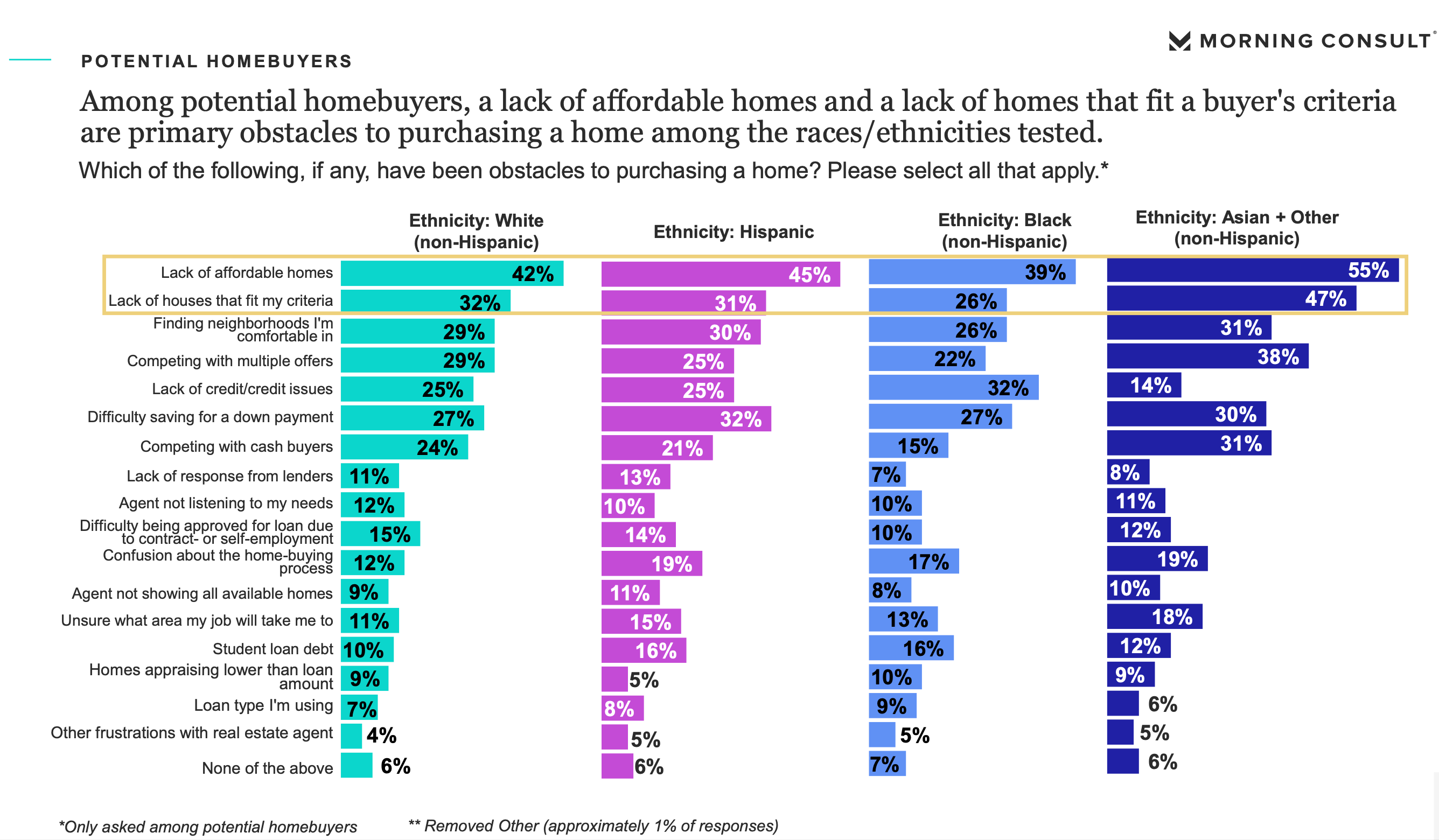
The lack of affordable homes for sale is the top challenge home buyers face in the current market, but it’s not the only one, according to the 2022 Obstacles to Home Buying, a new study released by the National Association of REALTORS® and Morning Consult.


Finding homes that fit buyers’ criteria, competing with multiple offers, and saving for a down payment also were commonly cited challenges. Homebuying obstacles, however, can vary by race and ethnicity, the study finds.


For example, Hispanic buyers also cited difficulty saving for a down payment as a pressing challenge that has delayed homeownership for some buyers.


Black buyers cited lack of credit or credit issues as the main obstacles, as well as finding neighborhoods to which they were comfortable moving.


White and Asian potential buyers said a lack of homes that fit their criteria and competing with multiple offers were their top current obstacles in purchasing a home.


A series of four bar charts showing the most common homebuying obstacles by race that people experience.


“Record-high home prices and record-low inventory have made the homebuying process exceedingly difficult,” says Jessica Lautz, NAR’s vice president of demographics and behavioral insights. “Our new study shows that while the inventory crisis is affecting potential buyers of every race, nearly all home buyers agree that homeownership is still an important part of the American dream.”


Indeed, among all races and ethnicities surveyed, a clear majority agreed that homeownership remains a part of the American dream.


But buying isn’t easy nowadays. About three-quarters of aspiring buyers surveyed say it will take them between six months and three years to save for a down payment.


While homeowners have enjoyed growing equity from rising home prices, buyers have faced plenty of hurdles. “The market becomes increasingly unaffordable, and the obstacles greater, for those trying to enter the market,” says Bryan Greene, NAR’s vice president of policy advocacy. “NAR advocates not only for existing homeowners but also for those aspiring homeowners whose entrance into the market is necessary for the economy to thrive.”


Source: “2022 Obstacles to Home Buying,” National Association of REALTORS® (April 12, 2022)


Tuesday, April 12, 2022

FAIR-HOUSING AD VIOLATIONS AREN’T ALWAYS OBVIOUS


Describe the property, not the potential buyer or tenant. “Ideal for empty nesters” or “perfect for students” raises red flags; “easy walk to train” does not.


Real estate professionals are legally obligated to uphold fair housing laws, and the language and images you use in advertising needs to be vetted carefully. Beyond the law, Realtors® also have an obligation to do so under Article 10 of the Realtor Code of Ethics.


“Advertisements should never indicate a preference or limitation based on a protected class, which at the federal level includes race, color, religion, sex, disability, family status and national origin,” says Mike Rohde, staff attorney at the National Association of Realtors® (NAR), in the latest “Window to the Law” video, Advertising Within the Fair Housing Framework.


“HUD recently expanded its interpretation of sex to include sexual orientation and gender identity, and state and local laws may expand the categories of protected classes further,” he adds.


Rohde provides a tip: When advertising a property, focus on describing the property – not the buyer or tenant. He cautions against using phrases like “ideal for empty nesters” or “perfect for students” that could raise red flags by implying a preference for one demographic over another.


On the other hand, he says phrases like “easy walk to train” or “beautiful Mexican doors” are likely acceptable since they describe the property’s characteristics.


Rohde says a similar rule of thumb applies when Realtors describe how they can help buyers or sellers – describe their services and not whom they want to serve. For example, it’s okay for agents to promote their fluency in a particular language or specialization, and the area of the community they serve. But they should avoid indicating a preference for or limitation to the clients they’ll serve, he says.


Real estate ads are judged using a reasonable person standard, which can evolve over time. Once-overlooked words and images, such as the Confederate flag, could create fair housing concerns nowadays.


April is Fair Housing Month, but NAR offers a suite of fair-housing resources and tools year-round on its website.


Source: NAR & Florida Realtors®