Thursday, October 21, 2021

The Helping Hand of REALTORS®


The REALTORS® Relief Foundation at 20: REALTORS® on the ground helping to make their communities whole.


Nashville, Tenn., March 1, 2020, 12:01 a.m.: “My phone emergency alert went off. It was dead silent outside. I turned on the TV to hear, ‘If you’re in East Nashville, you’re in danger.’ Then the TV went dead.


“I grabbed my son out of bed, screamed for my daughter, and lay on top of them in an internal hallway just as the tornado hit. ‘I have you.’ ‘I have you.’ ‘I have you,’ I kept saying to my kids. I could hear the walls moving, glass breaking, nails pulling from [boards], and the sudden boom of wind. Then it was over. We were there in the pitch dark with rain coming in. We lay low until morning and realized the devastation.”


By 6 a.m., Anna Altic, a broker with real estate company Parks, and her two children, Finn, now 14, and Annie, now 17, learned that parts of their roof were gone, their two cars were totaled, the carport and shed had disappeared, and every power line as far she could see had snapped, along with many of the tree-thick utility poles.


Among the first people to arrive to help the neighborhood clean up debris: REALTORS®. The first funds she saw—within about a week—were from REALTORS®, too.


Finding Hope


Altic, AHWD, EPRO, learned about grants available to victims of natural disasters—via the REALTORS® Relief Foundation—through her local association president, who called to check on her before daylight. She received a combined $2,000 from the RRF (disbursed by the Tennessee and the Greater Nashville associations), a much-needed short-term lifeline.


“It was a full-time job dealing with the insurers because there were different adjusters for the house and each of the cars, and they were all in different time zones,” Altic says. Her insurer considered the home habitable despite the damage and loss of electricity, which meant it wouldn’t fund a rental or hotel. To boot, it was weeks before she saw any insurance money.


“When you’re self-employed, you feel like an island sometimes,” Altic says. “I had this rough thing happen, and people who don’t have anything to gain from helping me are the first to jump in. I can’t wait to pay it forward.”


Fortifying the Future


The REALTORS® Relief Foundation has been paying it forward to disaster victims for 20 years, ever since the horrific attacks of 9/11. Over two decades, it has disbursed $33 million to help 17,000 families in 40 states and territories cope with the devastation of displacement and loss after a natural disaster. None of the money collected is used for administrative costs; those are absorbed by NAR to ensure 100% of donations make it to victims.


“When you go through something like this, you’re making so many decisions, dealing with so much information,” says RRF recipient Kim Wittman of Lawrence, Kan. “The last thing you have time to worry about where the money is coming from. Having the cash flow was a relief.”



Full-page ad for the REALTORS® Relief Foundation's Hope Rising fundraising campaign.


NAR


Despite this success, “we haven’t done a good job of letting our members know the foundation exists and exactly what it does,” says Mike Ford, RRF board president and a practitioner with Coldwell Banker Heritage Homes in West Memphis, Ark. “It’s the National Association of REALTORS®’ best-kept secret.”


The foundation is now in the midst of a campaign to raise $8.5 million—the same amount NAR raised and disbursed after 9/11. The eventual goal: Enable the 501(c)(3) to operate in perpetuity without relying significantly on real-time fundraising.


“We want the foundation to be less reactive [to disasters] and more proactive,” says Dave Legaz, a broker with Keller Williams Realty Landmark in Flushing, N.Y., and 2021 RRF campaign chair. Legaz, who is also serving this year as president of the New York State Association of REALTORS®, is a retired New York City Police Department sergeant who lost his partner during 9/11.


The campaign, called Hope Rising, launched June 28, 2021, and continues through 2021. In August, NAR and its subsidiaries—Second Century Ventures, SentriLock LLC, REALTORS® Information Network, Center for REALTOR® Development, and Realtors Property Resource®—contributed $1.25 million, the largest donation in the foundation’s history. Then, at a virtual commemorative event on Sept. 10, NAR President Charlie Oppler challenged all members to help the foundation reach its $8.5 million goal. The event took the campaign past the $7.2 million mark, 86% of the goal. (See the major donor list.)


If you want to help the foundation reach its goal, you’ll find donation and disclaimer information here.


Relief at the Ready


5-Year Cumulative Disbursement Totals


The foundation’s response to disaster is remarkably swift. State and local associations work directly with victims and can apply for RRF funding as soon as a national, state, or local official declares a state of emergency. Those with their own nonprofit foundations handle much of the process; others partner with NAR for services like accounting and disbursement. In all cases, the RRF board approves disaster relief grant applications put forth by associations.


Grant amounts depend on the severity of the disaster. If 20 homes are affected, the total grant might be $20,000, about $1,000 per family. After a large-scale event like a hurricane, grants can total several million dollars.


“We want the money to go as far as possible but also to have impact,” says RRF Board Vice President Leigh Brown. “$100 to someone in crisis doesn’t go anywhere. But $1,000 gives them a moment to process what comes next and get some necessaries covered like rent or mortgage.”


Relief often comes within days. Greg Larson and his wife left their Bismarck, N.D., home on a raft in March 2011 during what became a 93-day flood after sudden snow melt overburdened Missouri River dams. Larson’s total out-of-pocket repair costs came to about $90,000, and he was displaced for 18 months.


“We didn’t hear yes or no from the National Flood Insurance Program until August or September,” says Larson, GRI, an agent with Century 21 Morrison Realty. “But within seven days of being out of our home, we got a $1,000 check from the RRF. We got no other aid because the NFIP deemed the event prolonged water damage, not flood damage. That [$1,000] was cash to get us through the hard part, like the upfront expense of finding a place.”


The nine RRF board members take the urgency of their task seriously. “I can’t tell you how many times people have cleared their calendars [to expedite grants],” says Brown. “Board members’ hearts are in the outcomes, not in accolades.”


NAR staff provides the board with a package of information, including applications, photos, news reports, and verifications, ahead of their meetings. “By the time the RRF board sees the request, we don’t have to do any legwork,” Brown says.


RRF funds have occasionally had a worldwide impact, including support for a Habitat for Humanity project after the 2004 Indian Ocean tsunami. But the board now draws the line at international disasters because “we don’t have unlimited funds,” Brown says. “We have to focus where we have measurable impact. Still, we’re not going to say, ‘That’s how we’ve always done it.’ NAR and the RRF revisit their governance and structure [as needed]. That’s what I love about us.”


The First Day


On the morning of Sept. 11, 2001, NAR President Richard Mendenhall, of Columbia, Mo., was recovering from a double hernia operation. As he watched the Al Qaeda terrorist attacks unfold on TV, his military training as a Green Beret in Vietnam kicked in, and he circled the wagons. After making sure his leadership team and NAR staff were OK, he called an emergency meeting with his team—Martin Edwards Jr. of Memphis, Tenn., Pat Kaplan of Portland, Ore., and Cathy Whatley of Jacksonville, Fla. Many people might lose their homes due to loss of income: Was there anything NAR could do?


By the next day, the association had a plan to help victims’ families stay in their home with the caveat, Mendenhall insisted, “that not a penny go to promotions or administrative costs.” NAR teed up the giving with $1 million, then secured another $1 million from Fannie Mae. State and local associations and brokerages stepped in too. Mendenhall, who’s now an honorary RRF campaign co-chair along with his original team, even recalls a $3.50 donation from a little boy who heard about the effort on the radio.


Once various state associations identified the affected families, “we paid three months of mortgage or rent for each of them,” Mendenhall says. Working with REALTOR® volunteers and association staff in New York, New Jersey, Connecticut, Maryland, Massachusetts, Pennsylvania, Virginia, and Washington, D.C., NAR collected and paid out nearly $8.5 million—helping 1,333 families—in a period of just three months.


The powerful feeling of making a difference in the wake of the 9/11 attacks led to a broadened mission: serve as a beacon of hope for those suddenly displaced from their home by disaster. The foundation was born.


Stepping Up and Stepping In
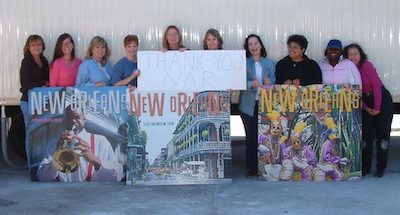


Thank You NAR


© New Orleans Metro Association of REALTORS®

An NAR-donated trailer, serving as a makeshift local association office, was just a small part of the relief funding that went to New Orleans after Hurricane Katrina in 2005.


With some disasters, simply getting to people to provide relief is fraught. The town of Lumberton, N.C., was devastated by Hurricane Matthew in 2016. Waist-high water, impassable roads, and lack of water or electricity left people stranded, remembers Linda Oxendine, the town’s tax collector, who, out of necessity, earned a battlefield promotion to disaster recovery director.


“[REALTORS®] were one of the best things that could happen to our city and county,” Oxendine says. “They were doing damage assessment even before FEMA could arrive.”


“REALTOR® volunteers showed up 7 days a week for weeks,” says Wendy Harris, ABR, CRS, who took a month off her practice as broker-owner of Team Harris Real Estate in Fayetteville, N.C., to volunteer in Lumberton.


Members created a Facebook group for town residents to communicate, set up a supply distribution point in a parking lot, canvassed neighborhoods to assess well-being and damage, and helped people complete RRF applications, Harris and Oxendine say. In addition, the REALTORS® worked with the mayor to stop the code enforcement department from condemning homes. The area is so impoverished that many residents would have no other housing options.


Further complicating matters was the difficulty of verifying who actually lived where, as many residents of this poor, rural town live in homes passed down over decades and without deeds or lease agreements in their name. Harris worked with Oxendine, who was able to confirm folks’ residency via tax records and utility payments.


Once that was squared away, the checks moved fast. “The grant money feels like a million dollars when you’re walking out with nothing,” Oxendine says.


Beyond financial relief and boots on the ground, members helped the town better prepare for the future, Oxendine adds. “They knew what information to collect and helped create a database to store the information so our response can be a lot faster.”


The community is now also training volunteer team leaders and high school students to emulate the REALTORS®’ canvass- ing efforts. “REALTORS® showed me the model,” she says.


It’s a model that plays out in every nook of the country every day, not just during natural disasters: Members volunteer in their communities to support the underprivileged, the sick, the challenged, and the unhoused. “REALTORS® are there in good and bad times,” says RRF Board President Ford. “[The RRF] solidifies the fact we’re the core of our community.”


For recipients like Larson in North Dakota, “it’s hard to explain an industry that’ll do that for you, right away, with few questions asked. It’s a real throat-catcher.”


Wednesday, October 20, 2021

Port St. Lucie named 8th best place in the U.S. to retire


Find your ideal retirement spot.


You might be able to save money and improve your quality of life by relocating to a retirement spot that better suits your interests and budget. A new U.S. News analysis compares the 150 largest metropolitan areas in the country as potential places to retire. The study includes data on housing affordability, happiness, desirability, retiree taxes, the job market and access to quality health care, and is weighted based on a U.S. News online survey of people age 45 and older about their retirement preferences.


U.S. News and World Report has named Port St. Lucie the 8th Best Place to retire in 2022.


In fact, Florida cities dominated the top 10 list, netting eight of those spots, including Sarasota (#1), Naples (#2), Daytona Beach (#3), Melbourne (#4), Tampa (#6), Fort Myers (#7), and Port St. Lucie at #8.


To identify the best places to retire, U.S. News analyzed data for the 150 largest metropolitan areas in the U.S. to assess how well they meet Americans’ retirement needs and expectations. The top cities are evaluated on overall happiness of residents, housing affordability, health care quality, retiree taxes, desirability, and job market strength.


To see the complete list, click here.


Tuesday, October 19, 2021

Is Now the Time to Boost Your Social Media Advertising?


Real estate pros are using this time to connect to prospects and past clients online. Building brand awareness using social media ad platforms may be cost-effective and could pay off in the long run too, according to a new study from Evocalize, a provider of marketing technology solutions for the real estate industry.


Evocalize, a 2019 member of the National Association of REALTORS®’ Second Century Ventures tech accelerator Reach program, analyzed more than 160 million ad impressions and behaviors generated over 70,000 leads from listing ads on Facebook apps and services. The analysis covers a month-over-month comparison between February to March.


Researchers found a 29% drop in media costs from Facebook advertising. “This is due to the increased amount of supply (available ad impressions) generated from the massive amount of people working from home and surfing Facebook,” the study notes. For example, the amount of video views on Facebook Live has doubled in just a week.


Also, the study notes a decrease in overall advertiser demand. Brands are reducing their marketing expenditures or halting them completely during the pandemic. The drop in demand has resulted in a drop in media rates too, the study notes.


Engagement and click-through rates have dropped somewhat during this time, the study notes. Researchers say this could because in-market buyers and sellers may still be browsing and viewing the ads but have less intent and are, therefore, clicking through less frequently.


Still, “the significant decrease in media costs, with the fluctuation in engagement and conversion metrics, leads to a near ‘business as usual’ approach to lead generation,” the report concludes. “The 15% increase in [cost per lead] means that for every $150 the average real estate agent spends on lead ads, they used to get about eight leads and now they are getting about seven leads.”


The significant drop in media costs could create an opportunity to “start building new relationships with clients and prospects,” the study notes.


Read the full study.


Source: “COVID-19’s Impact on Real Estate Advertising on Facebook,” Evocalize (2020)


Monday, October 18, 2021

FEMA’s Risk Rating 2.0


Nearly a decade of work to revamp the National Flood Insurance Program is upon us, and a lot of misinformation is being spread around. As the 2021 chair of NAR’s Insurance Committee, I would like to set the record straight and am pleased to report that on Oct. 1, FEMA began implementing a new flood insurance pricing methodology called Risk Rating 2.0: Equity in Action. REALTORS® have been calling for these changes since Congress passed the Biggert-Waters Flood Insurance Reform Act in 2012. FEMA heard your concerns and those of your clients and adopted most of the recommendations from NAR’s Insurance Committee.


These changes took effect Oct. 1 for new policies but will not take effect for renewal of existing policies until April 1, 2022. It is already clear that Risk Rating 2.0 will produce more accurate and equitable NFIP rates that better reflect the specific flood risk of each individual home.


What to Know About Risk Rating 2.0


  1. FEMA is replacing an inaccurate rating system that has not been updated in half a century and is not sustainable for homeowners or taxpayers. Imagine if you had to serve your clients based on 50-year-old technologies and only two pieces of information about a property—in this case, flood zone and base elevation certificate. If FEMA did not make these changes, NFIP rates would continue to climb 18% to 25% per year until reaching the current top rate of $63,000 for a $250,000 home under many policies.

  2. Risk Rating 2.0 will now price each home individually—rather than by zone—using modern industry technologies, more flood risk variables, and property-specific characteristics including elevation, distance to water, and cost to rebuild. One million homeowners will see a significant rate decrease at renewal while the majority of other homeowners will pay a slight increase or decrease. The new top rate in the program is $12,000 per year compared to $63,000 under the old system. Low-value properties also will no longer subsidize high-value properties, and elevation certificates are not required for an accurate rating.

  3. Because each property is now rated individually, only a licensed insurance agent will be able to tell your client whether their rate will increase or decrease under the new system. While flood insurance is outside real estate licensure and training, you can be a resource to your clients by identifying qualified insurance and flood risk professionals who can help answer their questions.


What Isn’t Changing Under Risk Rating 2.0


  1. Risk Rating 2.0 applies only to risk-based NFIP rates and will not affect flood mapping or insurance requirements, which will continue to be enforced by Congress, local communities and lenders.

  2. Grandfathered rates, including for newly mapped or pre-Flood Insurance Rate Map (FIRM) subsidized properties, will continue. By law, increases will not be more than 18% per year.

  3. Policyholders will still be able to transfer their grandfathered rates and other discounts to a buyer/new owner by assigning their flood insurance policy at the time of the sale of the property.


After the Biggert-Waters Act was enacted, NAR formed a member insurance committee to investigate the sudden, excessive flood insurance rate hikes and guide REALTORS® in the aftermath. We successfully convinced Congress to delay the rates for a decade while we hired independent actuaries and worked with FEMA to help diagnose the problem and propose solutions.


Risk Rating 2.0 is the culmination of thousands of member hours and research dollars as REALTORS® collaborated with and worked alongside FEMA to develop the new methodology. This outcome is not only a big win for consumers but also a powerful example of your RPAC dollars at work.


Friday, October 15, 2021

What's Happening This Weekend


Historic Downtown Art Walk


Art Walk


Treasure Coast Events

Date: Event occurs the third Friday of every month.

Time: 5:00 pm – 8:00 pm

Location: Treasure Coast Events IRC

Address: , , FL,

Price: Free

Category: Cultural


Every 3rd Friday, the rendezvous is at Downtown Fort Pierce, 5-8 PM! Join your local arts community on March 19 for the next Art Walk. Artists will line up the historic streets, and musicians and other performance artists will further entice you to visit art galleries and businesses. Plus, get discounts from participating retailers and much more. Mark your calendar! 3/19/21


******************************************


Touch A Truck


Date: Saturday October 16, 2021

Time: 10:00 am – 2:00 pm

Location: Indian River County Fairgrounds

Address: 7955 58th Ave, Vero Beach, fl 32967

Price: $5

Category: Kids / Family


Touch a Truck is a family friendly interactive event. Semi-trucks, monster trucks, military vehicles, excavators, backhoes, cranes, bulldozers, box trucks, fire engines, police cars, tow trucks, and more… are all welcome!!! They’re all SO COOL in the eyes of little (and big) kids. Touch A Truck celebrates learning, literacy, and family engagement through play. Please join us for this day of family fun.


******************************************


Fall Garden Festival


Date: Saturday October 16, 2021

Time: 10:00 am – 4:00 pm

Location: Heathcote Botanical Gardens

Address: 210 Savannah Rd., Fort Pierce, FL 34982

Price: Free admission

Category: Arts / Exhibits


Spend a beautiful day at Heathcote Botanical Gardens and enjoy our Fall Garden Festival. There will be plants for sale, food available for purchase along with fabulous vendors to shop as well as family activities, educational presentations and of course loads of fun! So, bring the family and join us!


******************************************


Freestyle Summer Fest


Freestyle Summer Fest Flyer


MIDFLORIDA Credit Union Event Center

Date: Saturday October 16, 2021

Time: 3:00 pm – 10:00 pm

Location: MIDFLORIDA Credit Union Event Center

Address: 9221 SE Event Center Pl, Port St. Lucie , FL, 34952

Price: Tickets at the door

Category: Concert / Live Music


Freestyle Summer Fest is brought to you by the Puerto Rican Association for Hispanic Affairs on October 16! Freestyle Summer Fest Flyer


Bringing the 90’S Freestyle Dance Music and the new school together on one stage feat Nyasia, & MORE, Giggles, Fascination, DJ MDW and DJ Morenito.


******************************************


Celebrating 50 Years of Ocean Science for a Better World®


Date: Thursday October 14, 2021 through Saturday April 30, 2022.

Time: 10:00 am – 5:00 pm

Location: Elliott Museum

Address: 825 NE Ocean Boulevard, Stuart, FL 34996

Price: Adults 13-64 – $14, Seniors 65+ – $12, Children 6 to 12 – $6, under 6 – free

Category: Arts / Exhibits


The Elliott Museum and Harbor Branch Oceanographic Institute are partnering to bring this one-of-a-kind exhibition with our community and visitors from around the world. From November 1,2021 through April 30, 2022, this display will include an up-close look at Harbor Branch’s famed Johnson-Sea-Link submersible and highlights from the organization’s rich history and current research. Special lectures and activities will be held at the museum during the exhibition starting in November.


Thursday, October 14, 2021

Where to Find Deepest Seasonal Discounts on Homes


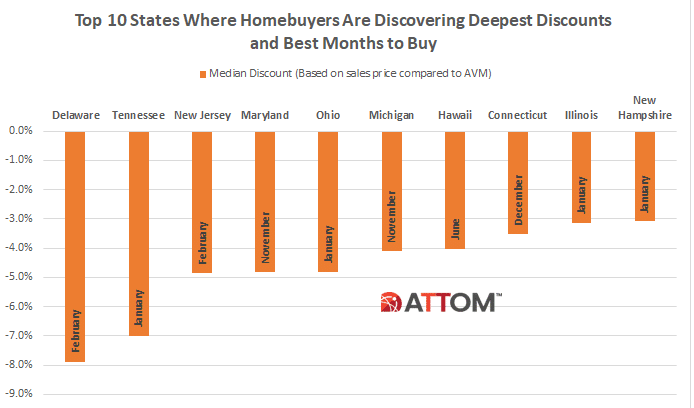
Home buyers nationwide tend to see the lowest premiums during October and during the winter months, according to a new analysis from ATTOM Data Solutions, a real estate data firm, of more than 33 million single-family home and condo sales over the past eight years.


Buyers may be more likely to find the deepest discounts in certain states during certain months of the year. ATTOM Data Solutions’ study reveals when. Most states see these opportunities in winter, but buyers in Hawaii should prepare for June as the summer heat begins.


The states that see the biggest discounts below full market value are:


  1. Delaware: –7.9% in February

  2. Tennessee: –7% in January

  3. New Jersey: –4.9% in February

  4. Maryland: –4.8% in November

  5. Ohio: –4.8% in January

  6. Michigan: –4.1% in November

  7. Hawaii: –4% in June

  8. Connecticut: –3.5% in December

  9. Illinois: –3.1% in February

  10. New Hampshire: –3.1% in January


A bar chart showing the top 10 states where would discover the biggest discounts and the best months to take advantage of them..


Wednesday, October 13, 2021

Buyers Are Realistic About Housing Shortage Challenges


House hunters are realizing they may need to expand their timelines to find a home. While they’re still anxious to buy, they are getting the messages about the competitive housing market and fierce bidding wars that they realize may delay their plans.


The share of consumers who hoped to buy a home in the next six months plummeted from 34% a year ago to 21% this year, according to a newly released homebuyer flash survey conducted by Point2 Homes, an online real estate marketplace.


But it’s not from a lack of eagerness: 50% of respondents said they were determined to buy as soon as they find the right property.


As one survey respondent from Dallas said, “I’ve been looking since December 2020 for a home but everyone keeps taking them off the market or increasing their pricing at a ridiculous amount.”


Concerns about housing shortages are increasing. But fewer respondents this year appear worried about their personal financial stability.


As such, the higher home prices aren’t scaring them away. Fifty-one percent of the more than 2,600 respondents said they were confident that the steep price hikes would not be a problem in their house hunt. On the other hand, 45% of consumers surveyed said they did not believe they’ll be able to keep up with the price hikes.


Also, buyers are still showing an interest in virtual home tours to shop for homes, but that interest does seem to be waning in favor of a return to in-person viewings. Interest in online pictures declined, while 11% of respondents expressed an interest in going to showing this year compared to just 4% last year, according to the Point2 Homes survey.


“Home seekers all across the U.S. remain positive about the home buying process, and seem more determined than ever to find the perfect home,” the report says. “Although the competition is fiercer than it has been in the past, many Americans are keeping their eyes on the market and are willing to play by the new rules—which imply more preparation, higher offers, and going through bidding wars without losing hope.”


Source: “Changes in Homebuyer Behavior & Expectations 1 Year Into the Pandemic,”